
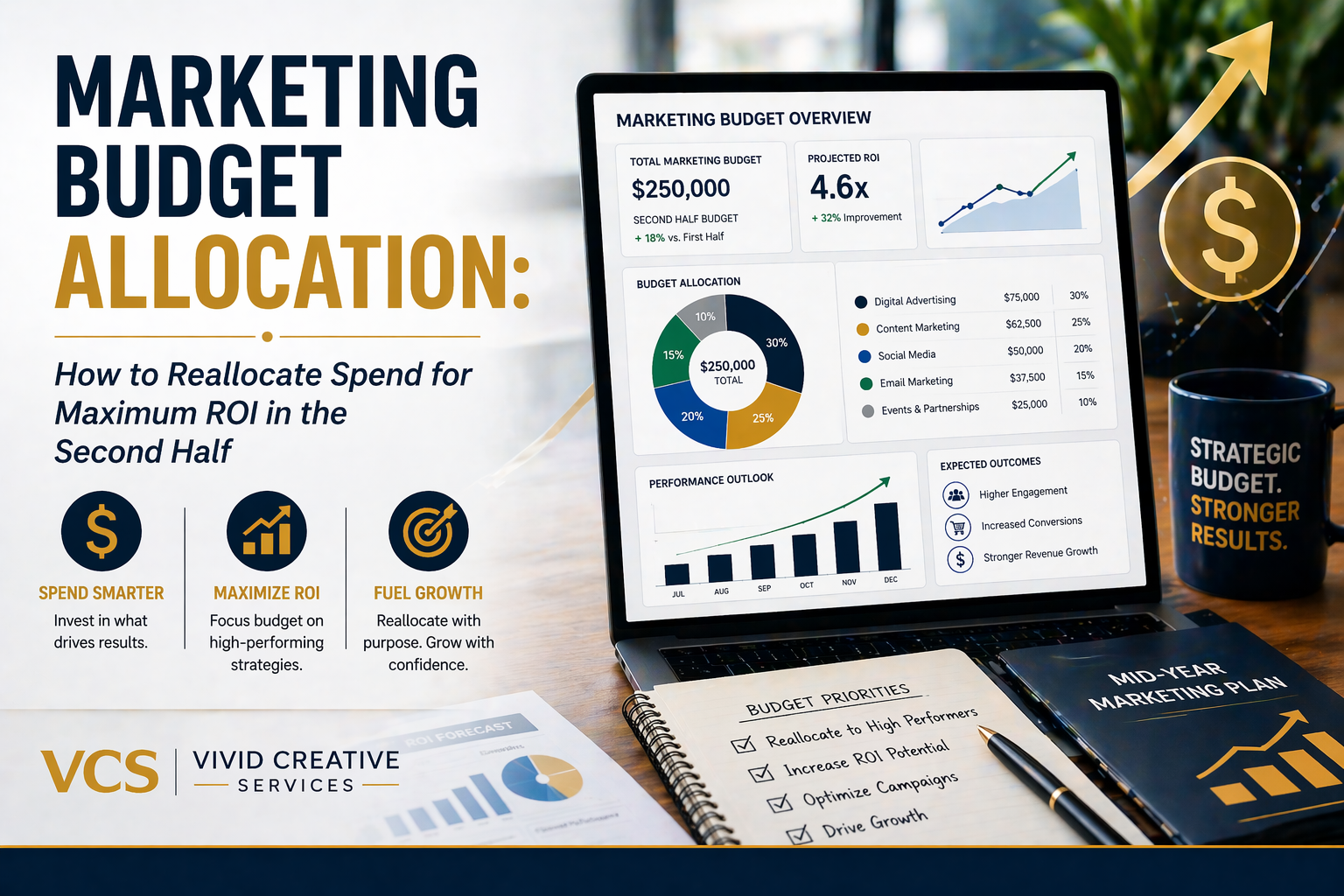

The Vivid Perspective Series: Mid-Year Marketing Reset Edition; Part 4 of 5; Insights on Branding, Marketing & Storytelling
Marketing Budget Allocation for Small Businesses, Nonprofits & Public Organizations: Why Smart Spending Drives Stronger Results
By mid-year, most organizations have already committed a significant portion of their marketing budget—but far fewer have stopped to ask whether that investment is delivering the results they expected. Whether you’re leading a small business, nonprofit organization, school district, or local government agency, marketing budget allocation is not just a financial decision—it’s a strategic one. Many teams fall into the trap of continuing to fund underperforming efforts simply because they were part of the original plan. But effective leaders understand that budgets are not fixed—they are flexible tools designed to maximize impact. A mid-year review gives you the opportunity to shift from passive spending to intentional investment. This is where you stop asking, “What did we plan to spend?” and start asking, “What is actually working?” When you align your budget with performance, you create the conditions for stronger results in the second half of the year.
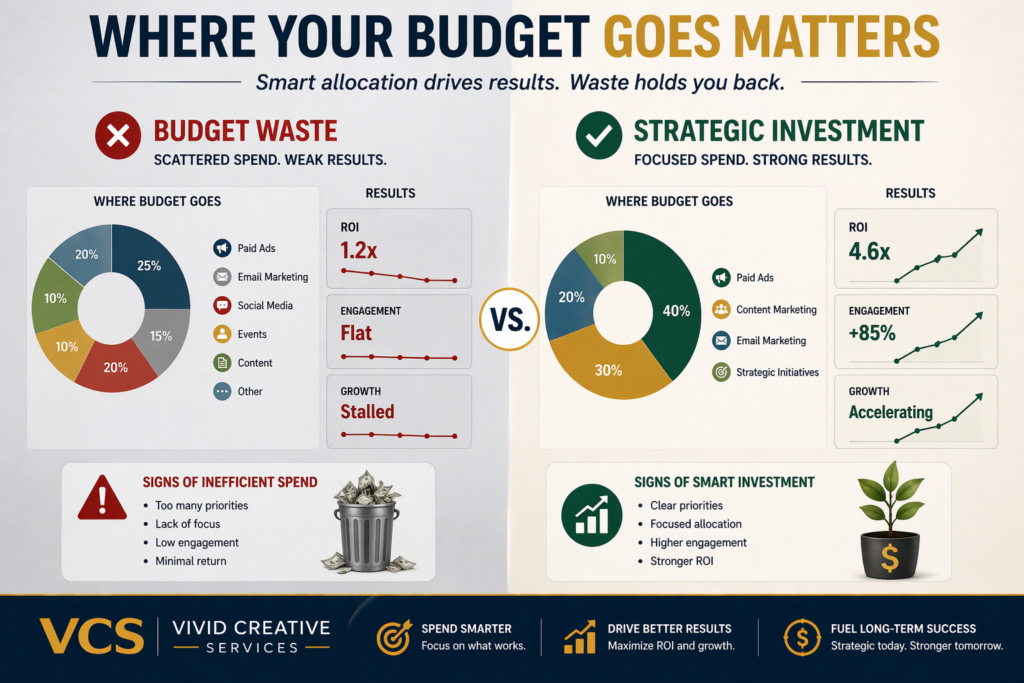
Before making adjustments, it’s important to understand the key questions leaders are asking about their marketing budget right now.
Top 25 Marketing Budget Questions Leaders Are Asking Right Now (And What They Reveal About Your Strategy)
At Vivid Creative Services, conversations around budget planning for marketing often reveal deeper strategic challenges, not just financial ones. These questions highlight uncertainty around ROI, prioritization, and performance.
Performance & ROI
- Am I getting a return on my marketing investment?
- Which channels deliver the highest ROI?
- How do I measure marketing ROI effectively?
- Why am I spending money without seeing results?
- What should I stop funding immediately?
Budget Allocation
- Am I allocating my budget in the right places?
- Should I reallocate my budget mid-year?
- How much should I invest in each channel?
- What percentage should go to digital vs traditional marketing?
- How do I prioritize limited resources?
Strategy & Planning
- Should I stick to my original budget plan?
- How often should I review my budget?
- What does a flexible marketing budget look like?
- How do I align my budget with my goals?
- What are the risks of not adjusting my budget?
Efficiency & Optimization
- Where am I wasting marketing spend?
- How do I reduce costs without reducing impact?
- What are quick wins for improving ROI?
- How do I optimize underperforming campaigns?
- When should I double down on what’s working?
Growth & Investment
- When should I increase my marketing investment?
- How do I scale successful campaigns?
- What channels should I test next?
- How do I balance short-term results with long-term growth?
- When should I bring in expert support to guide investment decisions?
These questions point to one truth: effective budget allocation is less about how much you spend and more about how well you spend it.
What This Means for You: If your budget decisions are not guided by performance and strategy, your results will remain inconsistent.
Now let’s define what effective marketing budget allocation looks like in practice.
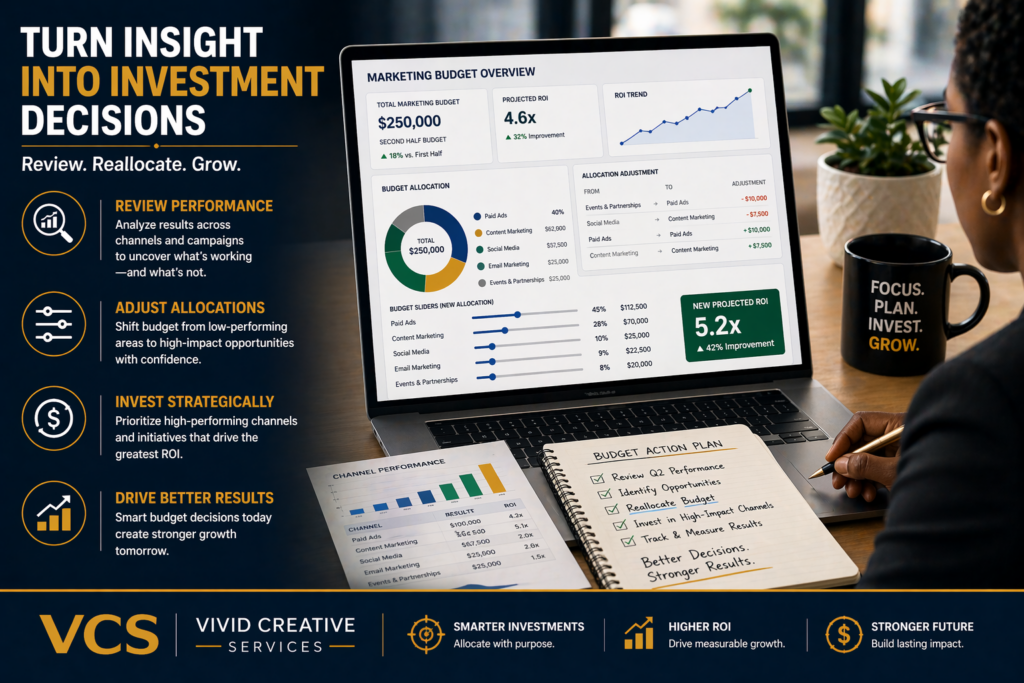
What Smart Marketing Budget Allocation Looks Like (And Why Most Organizations Get It Wrong)
Effective marketing budget allocation is rooted in alignment, data, and adaptability. Many organizations make the mistake of treating their budget as static—set at the beginning of the year and rarely revisited. This approach ignores the reality that marketing performance evolves over time. Smart organizations treat their budget as dynamic, making adjustments based on real-time performance and changing priorities. For example, a small business may discover that paid search is outperforming social media, while a nonprofit may find that email campaigns are driving stronger engagement than expected. Without flexibility, these insights go unused. Budget allocation should reflect what is working, not what was originally planned. When you align your budget with performance, you maximize efficiency and impact.
To put this into action, let’s walk through a structured approach to reallocating your marketing budget.
Step 1: Review Current Spend and Identify High- and Low-Performing Investments
The first step in improving your marketing budget allocation is understanding where your money is currently going. This includes reviewing all marketing channels, campaigns, tools, and resources. Identify which investments are delivering strong results and which are underperforming. For example, you may find that your paid advertising is generating leads, while your content efforts are not converting as expected. This step requires honesty and objectivity—what is working should be supported, and what is not should be reevaluated.
What This Means for You: Clarity about where your money is going is the foundation for smarter decisions.
Once you understand your current spend, the next step is aligning your budget with your most important goals.
Step 2: Align Budget Allocation With Your Strategic Priorities
Your budget should reflect your priorities—not the other way around. This means identifying your most important goals for the second half of the year and allocating resources accordingly. For example, if your priority is lead generation, your budget should focus on channels that drive conversions. If your goal is brand awareness, your investment may shift toward visibility and reach. Too often, organizations spread their budget across too many initiatives, which limits their ability to achieve meaningful results. Focus creates impact.
What This Means for You: If your budget is not aligned with your goals, your results will feel disconnected.
With alignment established, the next step is making strategic adjustments to improve ROI.
Step 3: Reallocate Resources to High-Performing Channels and Opportunities
This is where your audit turns into action. Based on your performance data, shift resources toward the channels and campaigns that are delivering the strongest results. This may involve increasing investment in paid advertising, expanding high-performing content, or enhancing your email marketing strategy. At the same time, reduce or eliminate spending in areas that are not producing results. For example, a local service business may increase its investment in local SEO, while a nonprofit may focus more on donor engagement campaigns. Reallocation is about maximizing impact—not increasing spend.
What This Means for You: Growth often comes from shifting resources—not adding more.
Now let’s ensure your budget is flexible enough to adapt as performance evolves.
Step 4: Build Flexibility Into Your Marketing Budget Strategy
A rigid budget limits your ability to respond to opportunities. Instead, build flexibility into your ROI-focused marketing spend by setting aside a portion of your budget for testing and optimization. This allows you to experiment with new channels, campaigns, or strategies without disrupting your core initiatives. For example, you may test a new advertising platform or pilot a targeted campaign for a specific audience segment. Flexibility enables innovation and continuous improvement.
What This Means for You: A flexible budget allows you to adapt, test, and grow more effectively.
Finally, let’s ensure your budget decisions are supported by ongoing review and optimization.
Step 5: Monitor, Measure, and Optimize Your Budget for Continuous Improvement
Budget allocation is not a one-time decision—it is an ongoing process. Regularly review your performance data, assess ROI, and adjust your budget as needed. This ensures that your investment continues to align with your goals and performance. For example, if a campaign begins to outperform expectations, consider increasing investment, while reducing spend in less effective areas. Continuous optimization ensures that your marketing remains efficient and effective.
What This Means for You: The best budgets are not fixed—they evolve with your strategy and performance.
From Budget Decisions to Business Growth: Turning Investment Into Impact
When your marketing budget allocation is aligned with performance and strategy, it becomes a powerful driver of growth. Instead of spreading resources thin, you focus on what works and scale it. This leads to stronger ROI, improved efficiency, and more predictable results. Budget decisions are not just financial—they are strategic levers that shape your organization’s success.
Marketing Budget FAQ: Quick Answers for Better Decision-Making
Should I change my marketing budget mid-year? Yes, if performance data indicates a need for adjustment.
What’s the biggest budget mistake? Continuing to fund underperforming efforts.
How do I improve ROI? Focus on high-performing channels and eliminate waste.
How often should I review my budget? Monthly or quarterly, depending on activity level.
Spend Smarter, Not More—And Maximize Your Results
A strategic approach to marketing budget allocation can transform your results in the second half of the year. By reviewing your spending, aligning your budget with your goals, reallocating resources, and continuously optimizing your investment, you position your organization for success. The goal is not to spend more—it’s to spend smarter.
Your Next Steps:
👉 Review your current marketing budget
👉 Identify one area to reallocate resources
👉 Align your spending with your top priority
👉 Explore the Year-End Marketing Playbook & Toolkit (Link)
👉 Schedule a Discovery Session with Vivid Creative Services (Link)