
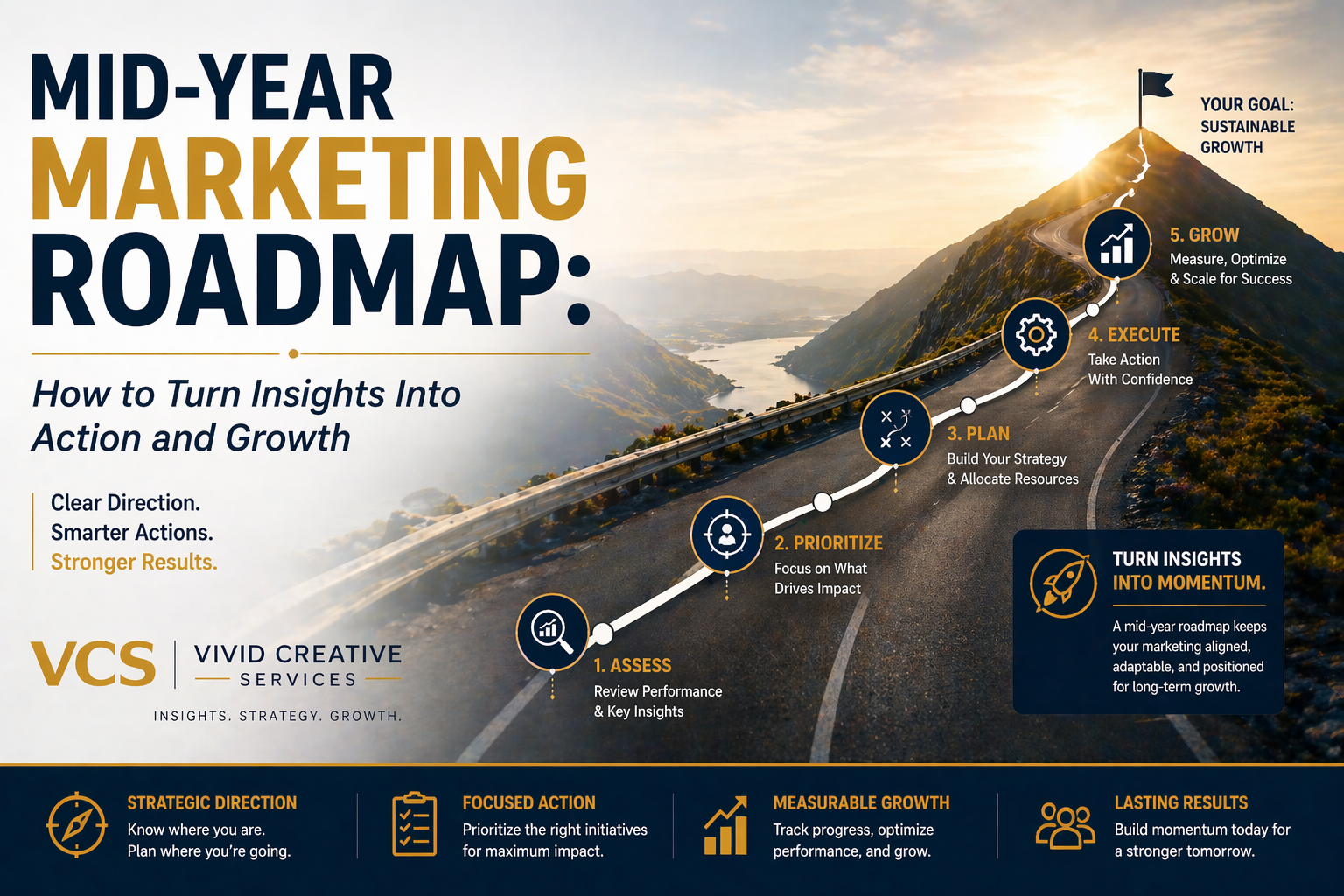

The Vivid Perspective Series: Mid-Year Marketing Reset Edition; Part 5 of 5; Insights on Branding, Marketing & Storytelling
Mid-Year Marketing Roadmap for Small Businesses, Nonprofits & Public Organizations: Why Strategy Without Action Falls Short
By this point in the year, you’ve done the hard work—you’ve reviewed your performance, evaluated your strategy, refined your audience, and reassessed your budget. But there’s one critical question that remains: What do we do next? Whether you’re leading a small business, nonprofit organization, school district, or local government agency, the difference between insight and impact comes down to execution. A mid-year marketing roadmap is the bridge that connects what you’ve learned to what you will do moving forward. Without a clear roadmap, even the best insights can stall, leading to hesitation, inconsistency, or missed opportunities. With a roadmap, your strategy becomes actionable, measurable, and aligned with your goals. This is where clarity turns into momentum—and momentum turns into results.
Before building your roadmap, let’s address the key questions leaders are asking when trying to move from strategy to execution.
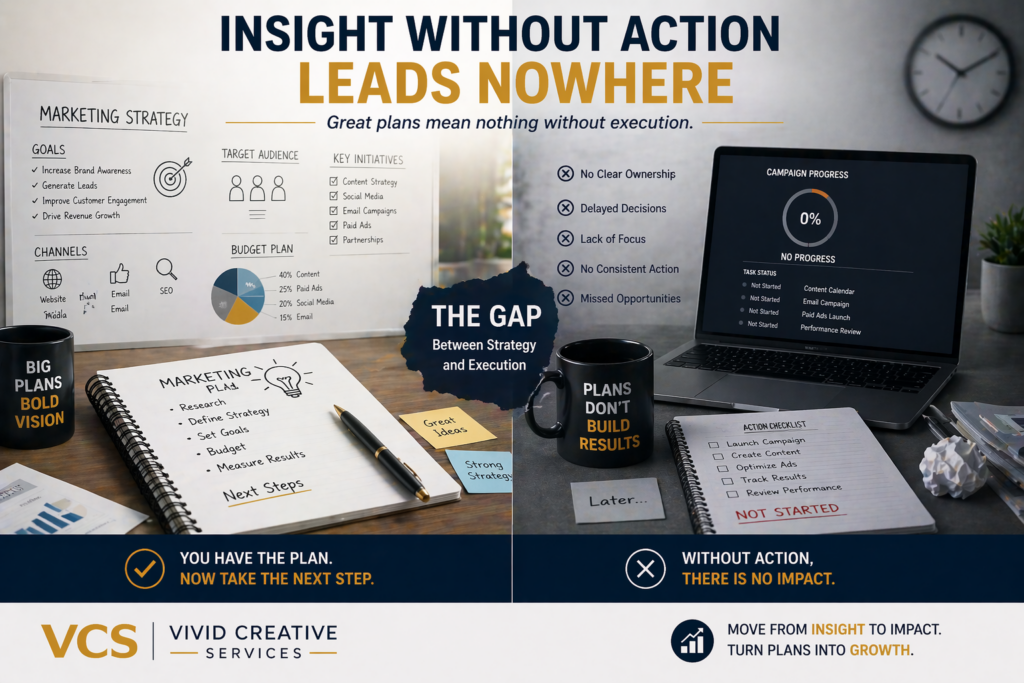
Top 25 Marketing Roadmap Questions Leaders Are Asking Right Now (And What They Reveal About Execution Gaps)
At Vivid Creative Services, we’ve found that most organizations don’t struggle with ideas—they struggle with implementation. The following questions highlight the most common challenges leaders face when creating an action plan for marketing.
Planning & Prioritization
- What should we focus on for the rest of the year?
- How do we prioritize our marketing efforts?
- What should we stop doing?
- How many initiatives should we run at once?
- How do we stay focused on what matters most?
Execution & Consistency
- How do we turn strategy into action?
- How do we stay consistent with marketing?
- Who should be responsible for execution?
- How do we manage multiple campaigns effectively?
- How do we avoid starting and stopping initiatives?
Performance & Measurement
- How do we track progress?
- What metrics should we monitor regularly?
- How do we know if our roadmap is working?
- How often should we review our plan?
- How do we adjust when things change?
Resources & Capacity
- Do we have the right team to implement this plan?
- How do we manage limited resources?
- When should we outsource or seek support?
- How do we balance strategy and execution?
- What tools or systems do we need?
Growth & Optimization
- How do we scale what’s working?
- What are quick wins we can implement now?
- How do we maintain long-term growth?
- How do we stay adaptable in a changing market?
- What does success look like by year-end?
These questions reveal a simple truth: clarity without action creates frustration—but clarity with action creates results.
What This Means for You: If you’re asking these questions, you’re ready to move from planning to execution—and that’s where real growth begins.
Now let’s define what an effective mid-year marketing roadmap actually looks like.
What a Strong Mid-Year Marketing Roadmap Looks Like (And Why Most Plans Fail Without One)
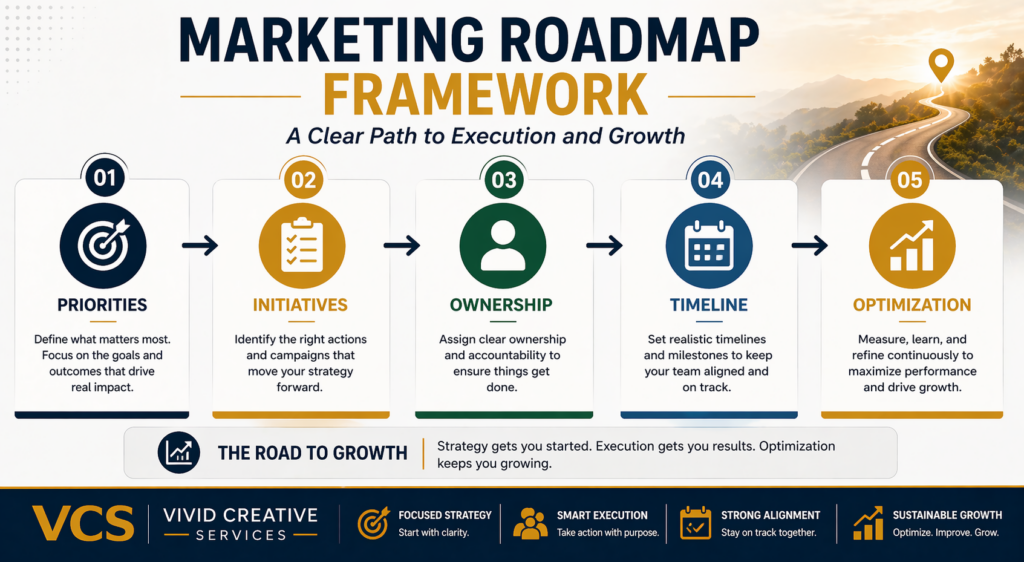
A strong mid-year marketing roadmap is not a long, complicated document, it’s a clear, focused plan that outlines what you will do, why it matters, and how it will be executed. Many organizations create plans that are too broad, too ambitious, or too disconnected from their resources. As a result, those plans rarely translate into consistent action. A roadmap should simplify—not complicate—your strategy. It should define your priorities, establish timelines, assign responsibilities, and set measurable outcomes. For example, a small business may focus on improving lead generation through targeted campaigns, while a nonprofit may prioritize donor engagement and retention initiatives. The key is to align your roadmap with your most important goals and ensure it is realistic given your capacity. A strong roadmap creates direction, focus, and accountability.
To build an effective roadmap, you need a structured process—one that transforms insights into clear, actionable steps.
Step 1: Define Your Top 3–5 Strategic Priorities for the Second Half of the Year
The first step in building your mid-year marketing roadmap is identifying your top priorities. These should be the initiatives that will have the greatest impact on your organization’s success. Instead of trying to do everything, focus on what matters most. For example, your priorities may include increasing lead generation, improving audience engagement, or strengthening brand visibility. Limiting your focus to 3–5 key initiatives ensures that your team can execute effectively without becoming overwhelmed. Prioritization is not about doing less, it’s about doing what matters most.
What This Means for You: Focus creates clarity, and clarity drives execution.
Once your priorities are defined, the next step is turning them into actionable initiatives.
Step 2: Break Priorities Into Clear, Actionable Marketing Initiatives
Once your priorities are established, the next step is breaking them down into specific actions. Each priority should be supported by initiatives that are clearly defined and easy to execute. For example, if your priority is lead generation, your initiatives may include launching targeted ad campaigns, optimizing landing pages, or creating lead magnets. If your goal is audience engagement, your initiative may focus on content creation and social media strategy. This step ensures that your roadmap is not just strategic—but actionable.
What This Means for You: Strategy becomes effective when it is translated into clear, executable actions.
Now that your initiatives are defined, the next step is assigning ownership and accountability.
Step 3: Assign Ownership, Roles, and Responsibilities for Execution
Execution requires accountability. Every initiative in your roadmap should have a clearly defined owner responsible for its success. This ensures that tasks are completed, progress is tracked, and results are achieved. For example, a marketing coordinator may manage content creation, while a leadership team member oversees strategy and performance. Without ownership, even the best plans can stall. Accountability ensures that your roadmap moves forward consistently.
What This Means for You: If no one owns it, it won’t get done—ownership drives results.
With ownership established, the next step is creating a realistic timeline.
Step 4: Establish Timelines, Milestones, and Performance Benchmarks
A roadmap without timelines is simply a list of ideas. This step involves setting clear deadlines, milestones, and performance benchmarks for each initiative. This helps your team stay on track and ensures progress is measurable. For example, you may set monthly goals for lead generation or quarterly benchmarks for audience growth. Milestones create momentum and provide opportunities to evaluate progress. A structured timeline keeps your roadmap focused and actionable.
What This Means for You: Timelines turn strategy into measurable progress.
Finally, let’s ensure your roadmap remains flexible and adaptable.
Step 5: Build in Regular Reviews and Adjustments to Stay Agile
No marketing plan remains perfect over time, which is why your roadmap should include regular review points. This allows you to assess performance, identify challenges, and make adjustments as needed. For example, you may conduct monthly check-ins or quarterly reviews to evaluate progress and refine your strategy. Flexibility ensures that your roadmap evolves with your organization and your market. Adaptability is a key driver of long-term success.
What This Means for You: A flexible roadmap allows you to respond to change and maintain momentum.

From Planning to Performance: Turning Your Marketing Roadmap Into Real Results
A well-structured mid-year marketing roadmap transforms insights into action and action into results. By focusing on priorities, defining initiatives, assigning ownership, setting timelines, and maintaining flexibility, you create a system that drives consistent progress. This is where strategy becomes execution—and execution becomes growth. Organizations that succeed are not the ones with the most ideas, they are the ones that take focused, intentional action.
Mid-Year Marketing Roadmap FAQ: Quick Answers for Better Execution
How detailed should my roadmap be? Clear and focused—not overly complex.
How often should I review my roadmap? Monthly or quarterly.
What’s the biggest mistake? Trying to do too much at once.
Can small teams execute effectively? Yes—with clear priorities and accountability.
Clarity + Action = Growth—Finish the Year Strong
A mid-year marketing roadmap is your opportunity to take everything you’ve learned and turn it into meaningful progress. By creating a clear, actionable plan, you position your organization for stronger performance, greater efficiency, and measurable growth in the second half of the year. The path forward is not about doing more—it’s about doing what matters most, with clarity and intention.
Your Next Steps:
👉 Define your top 3–5 priorities
👉 Build your marketing roadmap
👉 Align your team and resources
👉 Explore the Year-End Marketing Playbook & Toolkit (Link)
👉 Schedule a Discovery Session with Vivid Creative Services (Link)