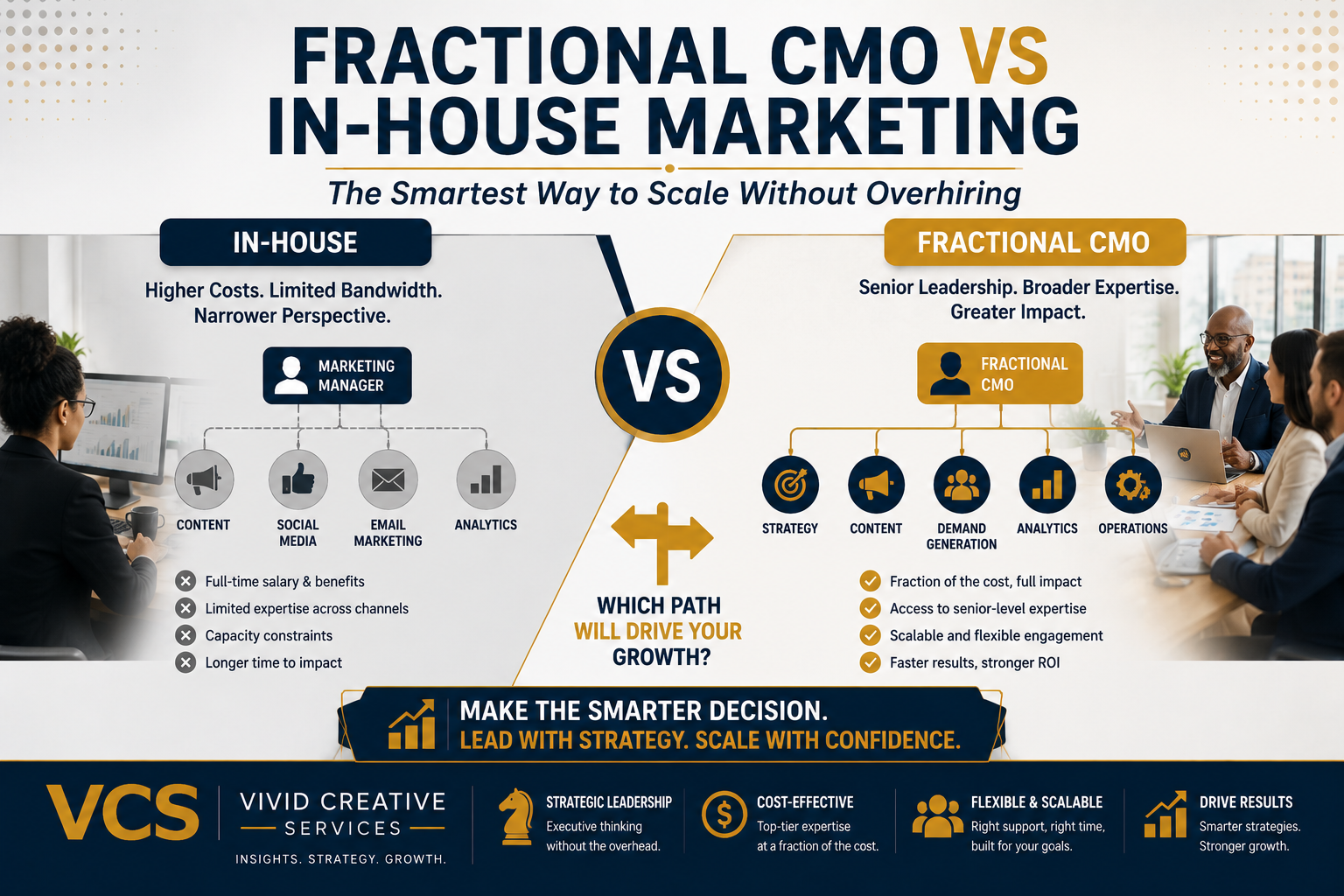

The Vivid Perspective Series: Insights on Branding, Marketing & Storytelling; Marketing Leadership for Growth: How Smart Organizations Scale with Strategy, Not Just Execution; Part 3 of 4
When Growth Stalls, the Problem Is Rarely Effort—It’s Structure
As organizations grow, marketing becomes more complex, more visible, and more critical to overall success. Teams expand, budgets increase, and expectations rise. Yet despite this increased investment, many organizations find themselves asking the same question: Why aren’t we seeing the results we expected? The answer often lies not in effort or even strategy, but in how marketing leadership is structured. Without the right structure, even strong strategies can struggle to gain traction. Execution becomes inconsistent, priorities shift, and accountability becomes unclear. Growth stalls not because teams are not working hard, but because the system supporting them is not designed for scale. Understanding how to structure marketing leadership is essential for organizations ready to move forward.
Who This Matters For: Leaders Making Hiring and Growth Decisions
This decision point is especially relevant for leaders responsible for growth, budget allocation, and team development. Whether you are a business owner scaling past early-stage growth, a nonprofit executive director balancing mission and resources, or a healthcare or education leader managing increasing demand, the question becomes unavoidable: How should we build our marketing function? Do you hire internally? Do you outsource? Do you build a hybrid model? Professional service firms and private equity-backed organizations often face this challenge at key inflection points. The decisions made at this stage have long-term implications for performance, cost, and scalability. Choosing the right structure is not just an operational decision, it is a strategic one.
Understanding the Three Common Marketing Structures
Most organizations operate within one of three marketing structures: in-house teams, outsourced vendors, or a hybrid approach. In-house teams offer proximity, internal knowledge, and day-to-day execution, but can be limited by experience or capacity. Outsourced vendors provide specialized skills and flexibility but may lack strategic alignment if not properly guided. Hybrid models combine internal resources with external support, offering a balance of execution and expertise. Each structure has its strengths and limitations, and none are inherently right or wrong. The key is understanding how each model aligns with your organization’s goals, stage of growth, and available resources. Without this clarity, organizations often default to familiar approaches rather than strategic ones.
What Is a Fractional CMO—and Why It’s Gaining Momentum
A Fractional Chief Marketing Officer (CMO) is an experienced marketing leader who provides strategic oversight on a part-time or contract basis. Unlike traditional consultants who may focus on specific projects, a fractional CMO operates as part of your leadership team, guiding strategy, aligning efforts, and ensuring accountability. This model has gained traction because it allows organizations to access senior-level expertise without the cost of a full-time executive hire. For many organizations, especially those in growth phases, this provides a practical and scalable solution. It bridges the gap between high-level strategy and day-to-day execution, ensuring that marketing efforts are both intentional and effective. As the demand for flexibility and expertise increases, the fractional model continues to gain relevance.
Fractional CMO vs In-House Marketing: Key Differences That Matter
When comparing a fractional CMO to an in-house marketing hire, the differences extend beyond cost. An in-house hire often brings focus and consistency but may require time to develop strategic perspective, particularly in complex or evolving environments. A fractional CMO brings immediate experience, offering strategic clarity from day one. In-house teams typically focus on execution, while fractional leadership focuses on direction, prioritization, and performance. Additionally, a fractional model provides flexibility, allowing organizations to scale involvement based on needs and budget. This is particularly valuable for organizations that are growing but not yet ready for a full-time executive role. Understanding these differences helps leaders make informed decisions that align with their goals.
25 Questions Leaders Ask When Deciding How to Structure Marketing
At this stage, leaders often find themselves asking critical questions. Do we need a strategist or more execution support? Can our current team scale with our growth goals? Are we investing in the right roles? How do we ensure accountability? What is the true cost of a full-time hire? How do we access senior-level expertise without overextending our budget? Should we outsource certain functions? How do we maintain alignment across teams and vendors? These questions reflect a deeper need for clarity around structure and leadership. Addressing them requires a thoughtful evaluation of both current capabilities and future goals. When leaders take the time to answer these questions, they are better positioned to build a marketing function that supports sustainable growth.
What This Looks Like in the Real World
Consider a growing healthcare practice that has invested in marketing staff and external vendors but continues to see inconsistent results. Campaigns are executed, but there is no clear strategy guiding them. The internal team is overwhelmed, and external partners lack direction. By introducing fractional marketing leadership, the organization gains a central point of accountability. Strategy is clarified, priorities are established, and both internal and external resources are aligned. The result is not more activity, but better coordination and improved performance. Over time, marketing becomes more predictable, and leadership gains confidence in the results. This example illustrates how structure can unlock the full potential of existing resources.
How This Connects to Strategic Marketing Planning
If you have been following this series, you understand that alignment is critical to marketing success. In our previous article, “Strategic Marketing Planning: How to Align Business Goals, Brand Growth, and Revenue,” we explored how to create a clear and intentional strategy (Click here to review the story). However, even the best strategy requires the right structure to be executed effectively. Without leadership to guide implementation, strategy remains theoretical. This is where structure and leadership intersect. Organizations that combine strong strategy with the right leadership model are better equipped to translate plans into results. This connection reinforces the importance of viewing marketing as a system rather than a set of isolated activities.
The Risk of Overhiring vs the Opportunity to Scale Smarter
One of the most common mistakes organizations make at this stage is overhiring to solve strategic challenges with additional execution capacity. While adding team members can increase output, it does not necessarily improve direction or alignment. This can lead to higher costs without corresponding improvements in performance. On the other hand, investing in strategic leadership allows organizations to optimize existing resources before expanding. This approach reduces waste, improves efficiency, and creates a stronger foundation for growth. Scaling smarter means focusing on what is needed most, rather than what feels most immediate. This shift in thinking is essential for long-term success.
How to Determine the Right Model for Your Organization
Choosing the right marketing structure begins with an honest assessment of your current state. Evaluate your team’s strengths and limitations, your budget, and your growth goals. Consider whether your primary need is strategic direction, execution support, or both. Identify gaps in leadership, alignment, and accountability. From there, explore options that address these gaps without overextending resources. For many organizations, a hybrid approach that includes fractional leadership provides the flexibility and expertise needed to move forward. The goal is not to adopt a specific model, but to build a structure that supports your unique needs and objectives.
A Proven Approach to Marketing Leadership: Strategy First, Then Execution
One of the most common mistakes organizations make when addressing marketing challenges is jumping directly into execution before establishing a clear strategy. At Vivid Creative Services, we take a different approach—one that is grounded in both experience and a proven framework. As a Certified fCMO+ Advisor, we are equipped with a structured, client-ready process designed to help organizations build smarter strategies and achieve consistent, sustainable growth.
Our philosophy is simple: Strategy First. Execution with Purpose. Results That Matter. We begin by developing a customized Strategic Marketing Blueprint—a clear, actionable plan that aligns your marketing efforts with your organizational goals, audience, and growth objectives. This blueprint serves as the foundation for all marketing activities, ensuring that every decision is intentional and aligned with outcomes that matter.
From there, organizations have the flexibility to engage at the level that best supports their needs. In some cases, leadership guidance is enough to empower internal teams to execute effectively. In others, we provide ongoing strategic leadership—often in a fractional CMO capacity—to ensure alignment, accountability, and performance. When needed, we also support implementation, working alongside internal teams or partners to bring the strategy to life. This flexible, layered approach allows organizations to scale their marketing intelligently, without overcommitting resources or sacrificing clarity.
Continue the Leadership & Strategic Marketing Series
If you’re building a stronger foundation for your marketing, each article in this series is designed to guide you step by step:
👉 Start Here: Marketing Leadership vs Execution: Why Your Organization Is Stuck (and How to Fix It) – LINK
👉 Then Read: Strategic Marketing Planning: How to Align Business Goals, Brand Growth, and Revenue – LINK
👉 Next Up: Strategic Growth Partnerships: How to Build Revenue, Equity, and Long-Term Wealth Through Collaboration – LINK
Each article builds on the last—helping you move from awareness, to alignment, to execution, and ultimately to growth.
Take the Next Step Toward Smarter Marketing Leadership
If you are evaluating how to structure your marketing for growth, now is the time to take a more intentional approach. Start by completing the Marketing Leadership Scorecard to assess your current strengths and identify gaps in strategy, alignment, and leadership. This simple step can provide valuable clarity on where to focus your efforts (Click here to get the scorecard).
From there, consider scheduling a Marketing Leadership Discovery Session with Vivid Creative Services. During this session, we will review your current approach, discuss your goals, and outline how a Strategic Marketing Blueprint can bring clarity and direction to your marketing efforts (Click to schedule your Discovery Session). Whether you need guidance, leadership, or support with execution, the right structure can transform marketing from a source of frustration into a driver of consistent growth.
MICRO FAQ
What is a Fractional CMO?
A Fractional CMO is a senior marketing leader who provides strategic oversight on a part-time or contract basis.
Is a Fractional CMO better than hiring in-house?
It depends on your needs. Fractional CMOs provide flexibility and expertise, while in-house teams offer consistency and execution.
When should a company hire a Fractional CMO?
When strategic leadership is needed but a full-time executive hire is not yet practical.
What is the difference between strategy and execution in marketing?
Strategy defines direction and priorities, while execution involves implementing campaigns and tactics.
Can small businesses afford a Fractional CMO?
Yes, the model is designed to provide high-level expertise at a more accessible cost.