
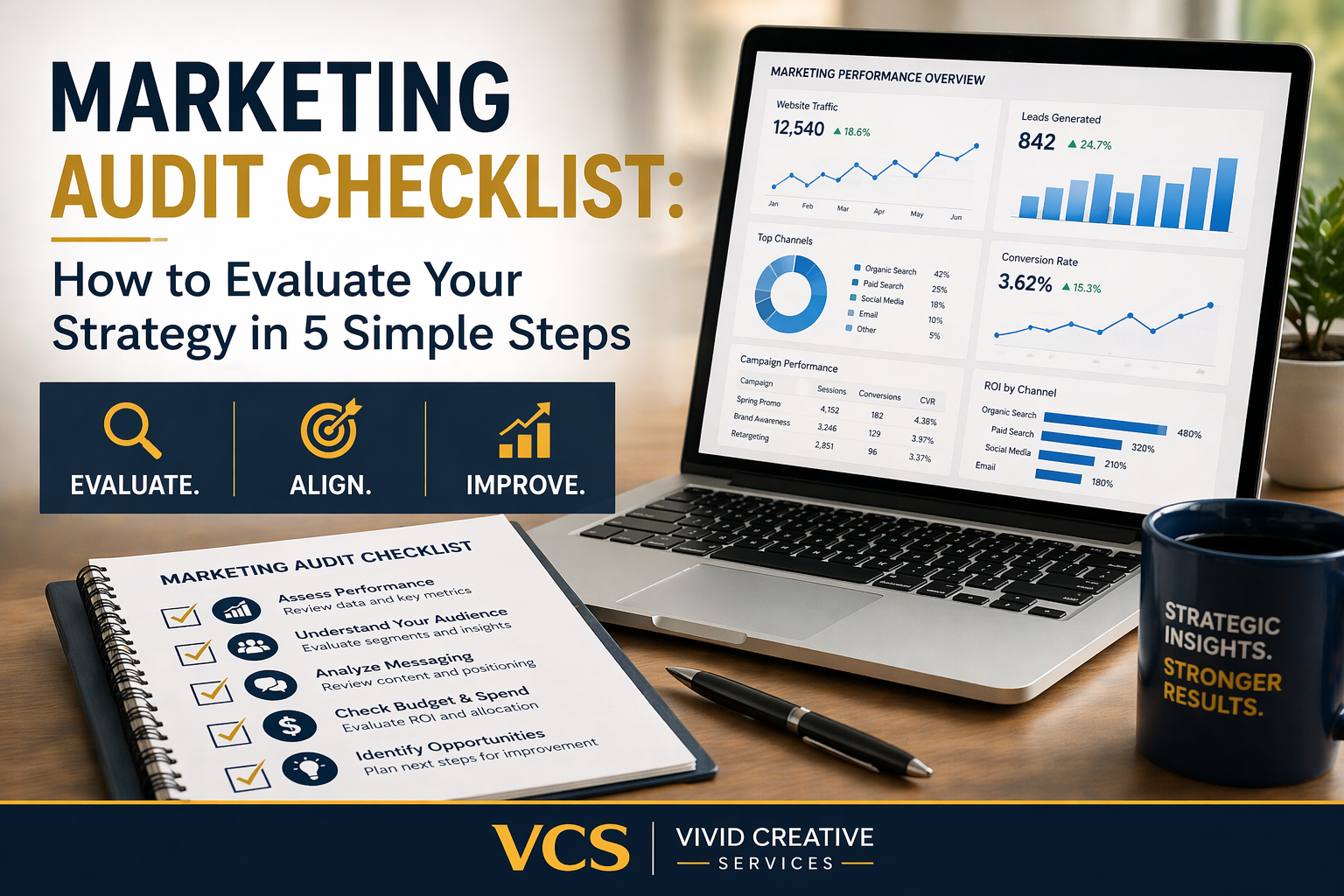

The Vivid Perspective Series: Mid-Year Marketing Reset Edition; Part 2 of 5; Insights on Branding, Marketing & Storytelling
Marketing Audit Checklist for Small Businesses, Nonprofits & Public Organizations: Why Evaluation Drives Better Results
If the mid-year marketing reset is about awareness, then a marketing audit is about clarity. Many organizations operate with the assumption that activity equals effectiveness—but without structured evaluation, it’s impossible to know what’s truly working. Whether you’re leading a small business, nonprofit organization, school district, or local government agency, the ability to assess your marketing strategy is one of the most valuable leadership skills you can develop. A marketing audit checklist provides a clear, repeatable way to evaluate your performance, identify gaps, and make smarter decisions. Without it, marketing becomes reactive, inconsistent, and difficult to measure. With it, your strategy becomes intentional, focused, and results-driven. This is where you move from guessing to knowing—and from knowing to improving.
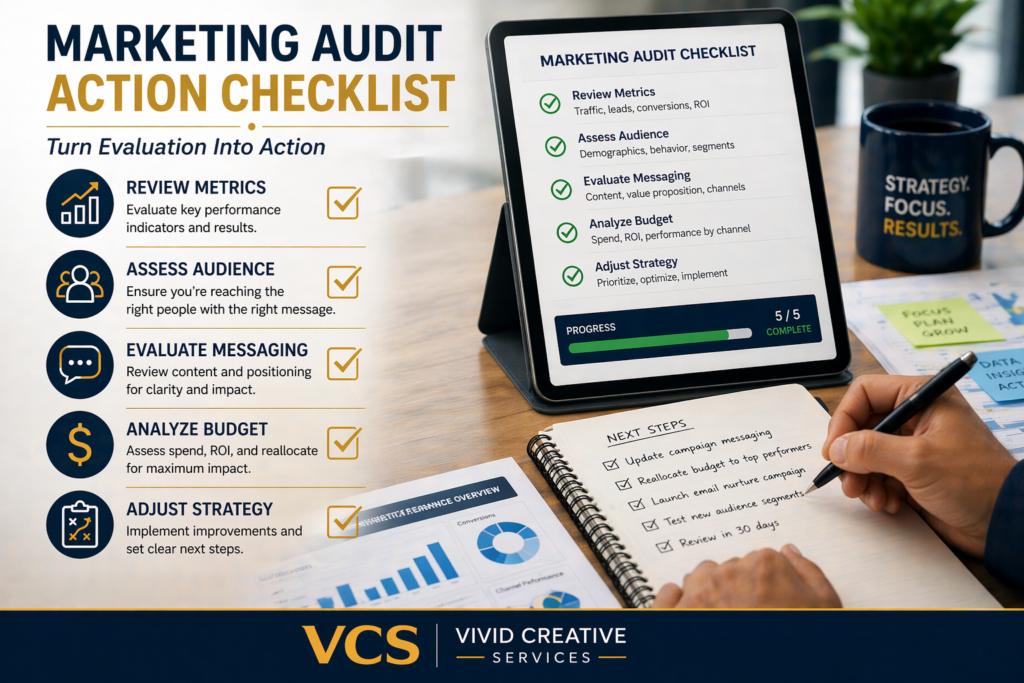
Before we walk through the audit process, let’s address the most common questions leaders ask when evaluating their marketing strategy.
Top 25 Marketing Audit Questions Leaders Are Asking Before They Evaluate Their Strategy
At Vivid Creative Services, we’ve found that most organizations don’t lack effort—they lack clarity. The following questions reflect the most common challenges leaders face when conducting a marketing review or business marketing evaluation, and they serve as a powerful starting point for your audit process.
Performance & Metrics
- What metrics should I be tracking right now?
- How do I know if my marketing is successful?
- Why am I not seeing measurable results?
- What does good performance look like for my organization?
- How often should I review my metrics?
Strategy & Alignment
- Is my marketing aligned with my business goals?
- What should I prioritize right now?
- Should I change my strategy or optimize it?
- What does a strong marketing strategy include?
- How do I evaluate long-term vs short-term impact?
Audience & Messaging
- Am I reaching the right audience?
- Is my messaging clear and compelling?
- Why isn’t my content converting?
- How do I improve engagement?
- How do I stand out from competitors?
Channels & Execution
- Which marketing channels are working best?
- Where should I focus my efforts?
- Am I using too many channels?
- How do I improve consistency?
- What should I stop doing?
Budget & ROI
- Am I spending my budget effectively?
- Where am I wasting resources?
- What delivers the highest ROI?
- How should I adjust my budget mid-year?
- When should I invest more—or pull back?
These questions are not obstacles, they are entry points into a smarter, more strategic marketing approach.
What This Means for You: If you can answer these questions clearly, you’re no longer guessing—you’re leading your marketing with intention.
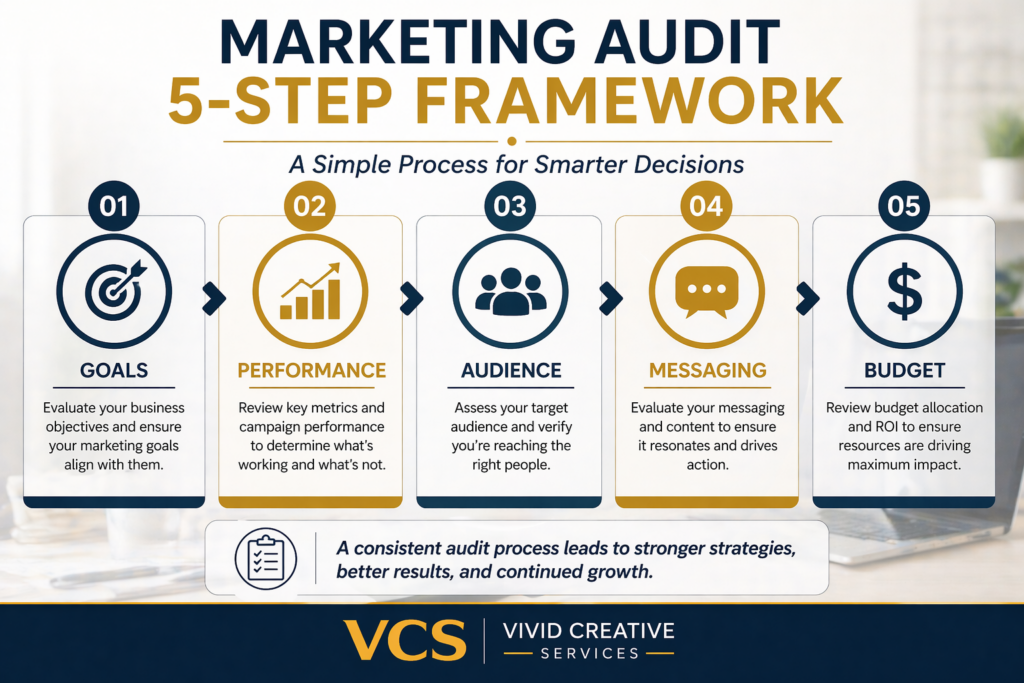
Now let’s walk through the structured process that will help you answer these questions with clarity and confidence.
Step 1: Evaluate Your Marketing Goals and Strategic Alignment
Every effective strategy audit begins with alignment. Before reviewing performance, you must ensure that your marketing efforts are connected to your overall business or organizational goals. This means clearly defining what success looks like—whether it’s increasing revenue, generating leads, growing membership, improving community engagement, or building brand awareness. Too often, organizations execute marketing tactics without a clear connection to outcomes, which leads to wasted effort and confusion. For example, a nonprofit may be running campaigns without aligning them to donor growth goals, while a small business may be focused on social media activity without a clear conversion objective. This step requires you to revisit your goals and confirm that your marketing strategy is designed to support them. Alignment is the foundation of effective marketing.
What This Means for You: If your marketing is not aligned with your goals, even strong execution will produce weak results.
Once your goals are clear, the next step is to evaluate how your marketing is actually performing.
Step 2: Analyze Performance Data and Identify What’s Working (and What’s Not)
Data tells the truth about your marketing performance—but only if you know how to interpret it. In this step, you’ll review key performance indicators such as website traffic, lead generation, conversion rates, engagement metrics, and campaign results. The goal is to identify patterns: what is consistently performing well, and what is underperforming. Many organizations fall into the trap of focusing only on vanity metrics, such as likes or impressions, without understanding how those metrics connect to actual outcomes. For example, high social media engagement may not translate into increased sales or inquiries. This step requires honest evaluation and a willingness to confront what the data is telling you. When you understand your performance, you gain the insight needed to make smarter decisions.
What This Means for You: Your data is not just information, it is direction. Use it to guide your next move.
After evaluating performance, the next step is ensuring that your marketing is reaching the right people.
Step 3: Review Your Target Audience and Positioning Strategy
Even the best marketing strategy will fail if it’s not reaching the right audience. This step focuses on evaluating your audience targeting strategy and ensuring that your messaging aligns with the needs, behaviors, and expectations of your ideal audience. Are you reaching the people most likely to engage with your organization? Are your campaigns attracting the right type of customer, donor, or community member? If not, it may be time to refine your audience segments or adjust your targeting approach. For example, a service-based business may discover that its messaging is too broad, while a school district may need to better segment prospective families based on specific needs. Effective targeting is about precision, not volume.
What This Means for You: Reaching more people is not the goal—reaching the right people is.
Once your audience is clearly defined, the next step is evaluating how well your message connects.
Step 4: Assess Your Messaging, Content, and Brand Clarity
Your messaging is the bridge between your organization and your audience—and if that bridge is unclear, your marketing will struggle to perform. In this step, you’ll evaluate your value proposition, brand messaging, and content strategy to determine whether they are clear, compelling, and consistent. Ask yourself: Does your audience understand what you offer? Do they see the value? Are you communicating in a way that resonates with their needs and priorities? Many organizations struggle not because they lack value, but because they fail to communicate that value effectively. For example, a nonprofit may have a strong mission but unclear messaging, while a small business may offer great services but fail to differentiate itself from competitors. Strong messaging turns attention into action.
What This Means for You: If your audience is confused, they will not convert—clarity is your competitive advantage.
Now that your messaging is aligned, the final step is evaluating how your resources are being used.
Step 5: Review Your Marketing Budget, Channels, and Resource Allocation
The final step in your marketing audit checklist is to evaluate how your budget and resources are being allocated across your marketing efforts. This includes reviewing your spending across channels, assessing ROI, and identifying opportunities to reallocate resources for better results. Many organizations spread their budget too thin across too many initiatives, which limits their ability to achieve meaningful impact. Instead, focus on investing in the channels and strategies that are delivering the strongest results. For example, if paid advertising is generating leads, consider increasing investment, while reducing spend on underperforming channels. Strategic allocation is about focus, not expansion.
What This Means for You: Where you invest your resources determines the results you achieve—choose wisely.
From Audit to Action: How to Turn Your Marketing Evaluation Into a Clear Strategy
Completing a marketing audit is a powerful step—but its true value comes from what you do next. Once you’ve evaluated your strategy, performance, audience, messaging, and budget, the next step is to translate those insights into a clear action plan. This may include refining your strategy, reallocating your budget, improving your messaging, or focusing on high-performing channels. The key is to prioritize actions that will deliver measurable impact in the second half of the year. This is where evaluation becomes transformation.

Mid-Year Marketing Audit FAQ: Quick Answers for Better Decision-Making
How often should I conduct a marketing audit? At least twice a year, with mid-year being a critical checkpoint.
Do I need to change everything? No—focus on optimizing what works and improving what doesn’t.
What’s the most important part of an audit? Alignment between your goals and your strategy.
Can small teams do this effectively? Yes, with a structured checklist and clear priorities.
Clarity Creates Confidence—And Confidence Drives Results
A marketing audit checklist is more than a tool—it is a strategic advantage. It allows you to step back, evaluate your efforts, and make informed decisions that improve performance and drive results. The organizations that succeed are not the ones that do the most, they are the ones that do what matters most, with clarity and intention.
Your Next Steps:
👉 Conduct your Marketing Audit using this 5-step framework
👉 Explore the Year-End Marketing Playbook & Toolkit (Link)
👉 Schedule a Discovery Session with Vivid Creative Services (Link)