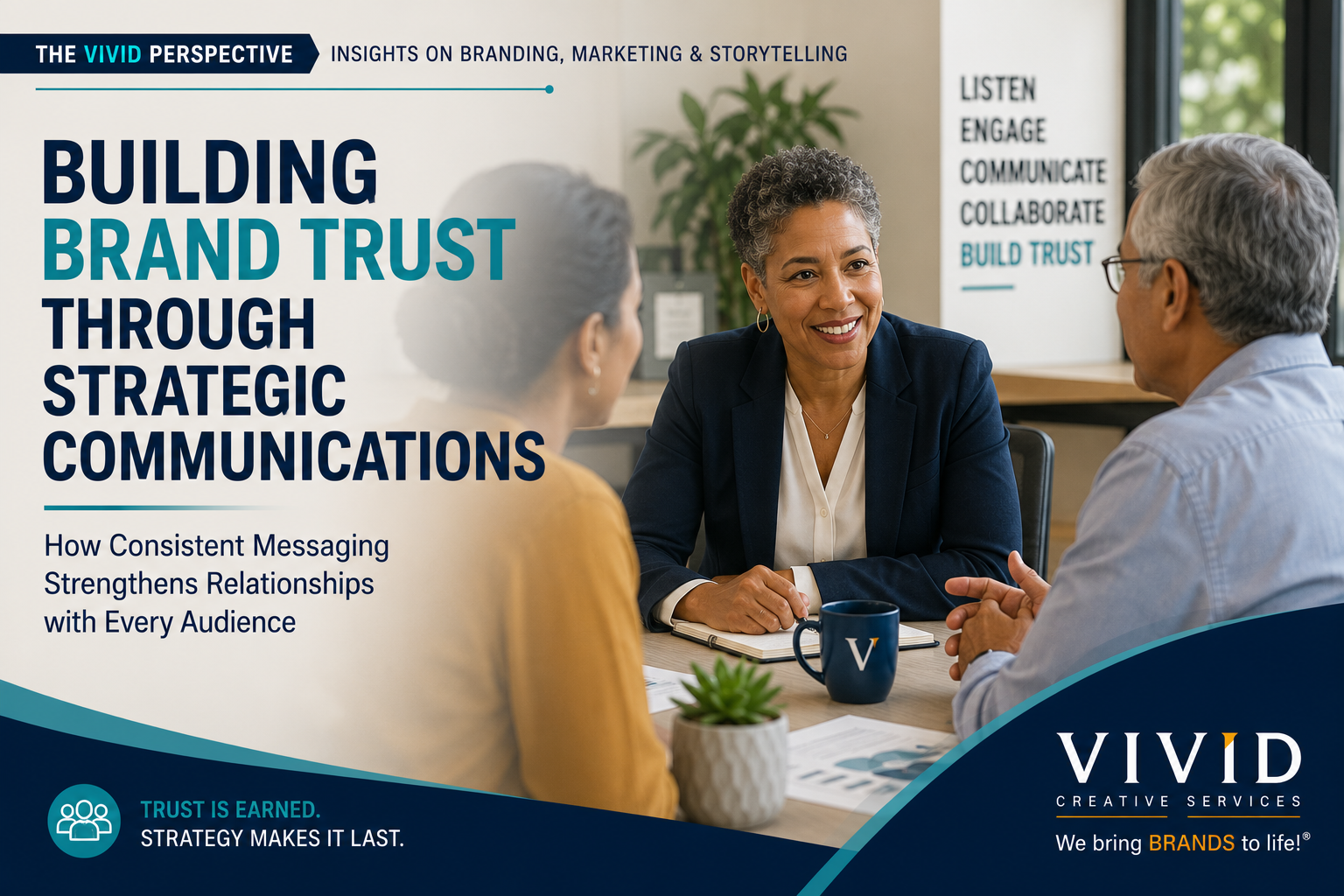

How Consistent Messaging Strengthens Relationships with Every Audience
The Vivid Perspective: Insights on Branding, Marketing & Storytelling; Strategic Communications: Building Visibility, Credibility & Trust; Story 3 of 4
Quick Answer: How do you build brand trust through strategic communications?
If there’s one lesson every leader should remember, it’s this: People don’t decide whether to trust your organization based on one message. They decide based on the consistency of every message, every interaction, and every experience they have with your brand.
Trust is built when communication aligns with action. When leaders say one thing and employees demonstrate another, trust weakens. When organizations promise exceptional service but fail to deliver, trust erodes. When communication becomes inconsistent during periods of growth or change, confidence begins to decline.
Conversely, organizations that communicate with clarity, transparency, authenticity, and consistency create something far more valuable than awareness. They create confidence.
That confidence influences nearly every organizational outcome:
- Customers become loyal advocates.
- Donors give with greater confidence.
- Patients feel more comfortable choosing your care.
- Families recommend your school.
- Employees become ambassadors.
- Community partners seek collaboration.
- Journalists recognize credibility.
- Stakeholders support long-term growth.
Trust isn’t a marketing campaign. It’s the cumulative result of thousands of intentional decisions made over time. Strategic communications simply ensures those decisions consistently reinforce the reputation your organization wants to earn.

Why Trust Is Every Organization’s Most Valuable Asset
Think about the organizations you trust most. Perhaps it’s the local healthcare provider you’ve relied on for years. The neighborhood business that consistently exceeds your expectations. The nonprofit whose mission inspires your support. The school your family proudly recommends to others. Or the public institution that communicates honestly—even when the news isn’t easy to share.
Now ask yourself an important question: What created that trust? It probably wasn’t one marketing campaign. It wasn’t a television interview. It wasn’t one social media post.
And it certainly wasn’t one advertisement.
Trust was built gradually through a series of consistent experiences. Promises were made—and kept. Questions were answered honestly. Challenges were communicated transparently. Leaders demonstrated integrity. Employees reinforced the same values.
Over time, confidence grew. That’s how trust is built.
Unfortunately, many organizations unintentionally approach trust very differently. They invest heavily in marketing campaigns designed to increase awareness. They refresh their websites. They redesign their logos. They launch advertising campaigns. They create new messaging. While all of these initiatives can be valuable, they often overlook something much more important.
Trust isn’t created by what organizations say about themselves. It’s created by whether every interaction consistently reinforces what they claim to believe. That’s why trust should never be viewed as simply a marketing objective. It’s a leadership responsibility.
Every email. Every conversation. Every employee interaction. Every customer experience.
Every community partnership. Every social media post. Every public statement. Every decision communicated during times of uncertainty. Together, these moments shape how people perceive your organization.
In today’s environment, that perception matters more than ever.
Customers have more choices. Donors have more causes to support. Families have more educational options. Patients have more healthcare providers. Employees have more career opportunities. Communities have more information than at any point in history.
Trust has become one of the few competitive advantages that cannot be easily copied.
Products can be replicated. Services can be matched. Technology changes rapidly.
But an organization’s reputation—earned through years of consistent leadership and authentic communication—is remarkably difficult to duplicate.
That is why strategic communications extends far beyond marketing. Its purpose is not merely to increase visibility. Its purpose is to strengthen relationships. And relationships built on trust become one of an organization’s most valuable long-term assets.
Why Trust Matters More Than Ever
Trust has always been important. Today, it’s essential. Every day, people are exposed to thousands of messages competing for their attention.
- Advertisements.
- Emails.
- News stories.
- Social media updates.
- Videos.
- Podcasts.
- Artificial intelligence-generated content.
- Influencer recommendations.
- Corporate announcements.
- Political messaging.
The sheer volume of information has changed the way people evaluate organizations.
Instead of asking, “What is this organization saying?” People increasingly ask, “Can I believe them?” That shift has significant implications for leaders.
Communication is no longer measured solely by how effectively it informs. It’s measured by how successfully it builds confidence. Stakeholders expect more than polished messaging. They expect transparency. Authenticity. Consistency. Accountability.
Organizations that communicate openly—even when circumstances are difficult—often strengthen trust because people value honesty more than perfection. Conversely, organizations that remain silent, provide inconsistent information, or overpromise risk damaging credibility far more quickly than they realize.
Trust has also become one of the strongest drivers of organizational growth.
When trust is high:
- Prospective customers become customers.
- Satisfied customers become advocates.
- Employees become recruiters.
- Volunteers become ambassadors.
- Donors become long-term supporters.
- Community partners become collaborators.
- Media relationships become stronger.
- Leadership credibility increases.
- Growth accelerates because confidence reduces uncertainty.
People naturally prefer doing business with organizations they trust.
- Supporting organizations they trust.
- Working for organizations they trust.
- Partnering with organizations they trust.
This is why trust should never be viewed as an intangible concept. It’s a measurable organizational asset. And strategic communications is one of the most powerful tools leaders have to strengthen it intentionally. Every communication either reinforces trust—or weakens it. There is rarely a neutral outcome.
The question leaders should continually ask themselves is not, “Did people hear our message?” Instead, ask, “Did our communication strengthen their confidence in who we are?”
That’s the question that transforms communication from a marketing function into a strategic leadership discipline. And that’s precisely where organizations begin building reputations that endure.
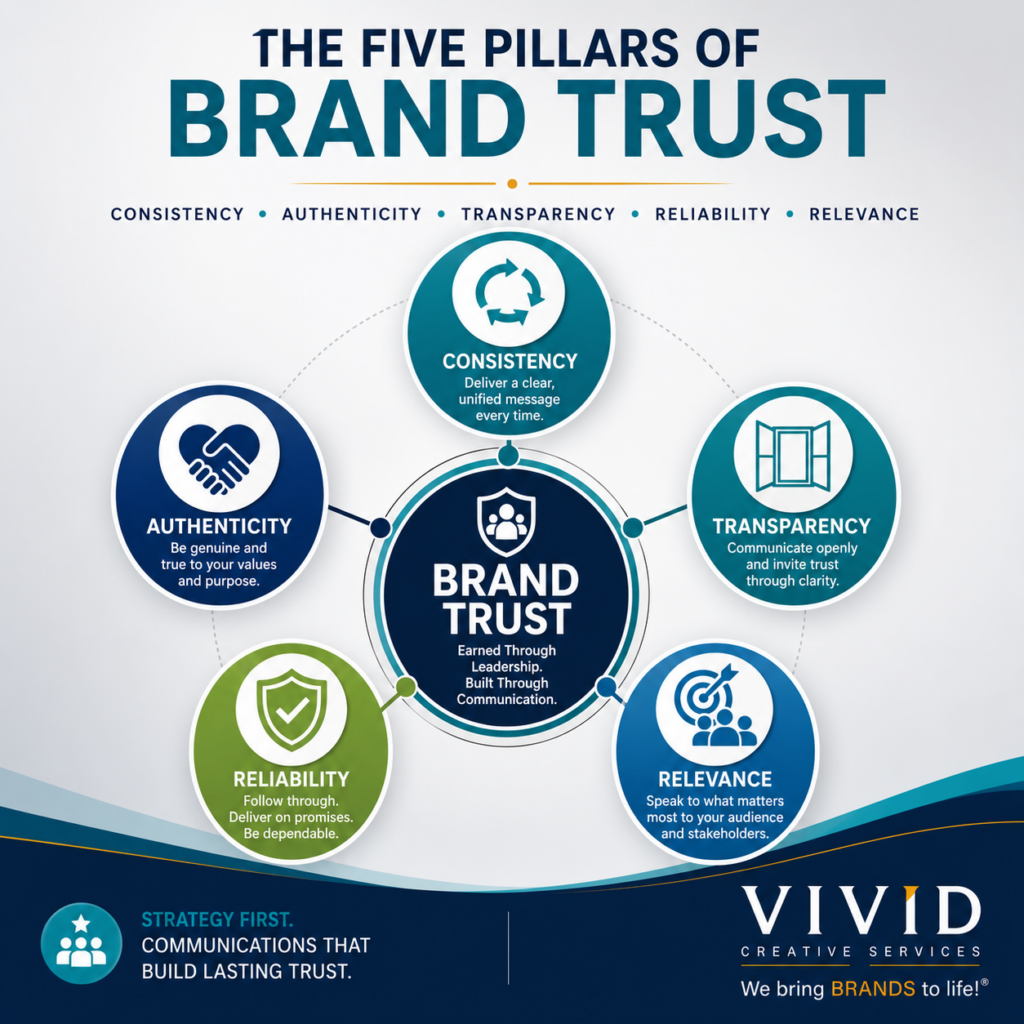
The Five Pillars of Brand Trust
Trust is often described as something organizations either have or don’t have.
In reality, trust is built intentionally. It grows through consistent behaviors, thoughtful leadership, and strategic communication over time.
Organizations rarely lose trust because of one isolated event. More often, trust slowly erodes through inconsistent messaging, unmet expectations, poor communication, or a disconnect between what an organization promises and what people actually experience.
The encouraging news is that the opposite is also true. When organizations consistently communicate with integrity, transparency, and purpose, trust compounds. Every positive interaction reinforces the next.
Based on more than two decades of working with organizations across the public, private, nonprofit, healthcare, and education sectors, I’ve found that lasting trust is built on five essential pillars. These aren’t marketing tactics. They’re leadership disciplines.
Pillar 1: Consistency
Trust begins with consistency. People should experience the same organization regardless of who answers the phone, responds to an email, updates social media, greets them at the front desk, or speaks on behalf of the organization.
Your mission shouldn’t change depending on who’s telling the story. Your values shouldn’t sound different from one department to another. Your promises shouldn’t vary across communication channels.
Consistency creates familiarity. Familiarity creates confidence. Confidence creates trust.
Organizations often invest significant time creating brand standards for logos, colors, and typography. Those elements certainly matter. But equally important is creating communication standards that ensure everyone communicates the same purpose, values, and organizational story.
The strongest brands aren’t recognized because they repeat the same slogan. They’re recognized because they consistently reinforce the same experience.
Pillar 2: Authenticity
People connect with organizations that feel genuine. Authenticity doesn’t mean being perfect. It means being honest.
Every organization encounters challenges. Programs evolve. Markets change.
Projects experience setbacks. Leaders make difficult decisions.
Authentic organizations acknowledge reality rather than attempting to create the appearance of perfection. They celebrate successes with humility. They communicate challenges with honesty. They explain decisions with clarity. Authenticity builds credibility because people recognize sincerity.
In a world increasingly influenced by automation and artificial intelligence, authentic human communication has become even more valuable. People don’t expect perfection.
They expect honesty.
Pillar 3: Transparency
One of the fastest ways to weaken trust is leaving people to fill information gaps themselves.
When communication is delayed, incomplete, or inconsistent, people naturally begin creating their own explanations. Those assumptions are often far more damaging than the truth.
Transparency doesn’t require organizations to disclose every internal decision. It requires communicating openly about the decisions that affect stakeholders. Explain what has changed. Explain why. Explain what’s next.
Whether communicating with customers, employees, parents, donors, patients, volunteers, or community partners, transparency demonstrates respect. People may not always agree with difficult decisions. But they almost always appreciate understanding them.
Pillar 4: Reliability
Trust grows when organizations consistently deliver what they promise.
This sounds simple. In practice, it’s one of the greatest leadership challenges organizations face.
Reliability extends beyond products and services. It includes returning phone calls.
Meeting deadlines. Following through on commitments. Responding promptly.
Providing accurate information. Maintaining quality. Being present when people need you most.
Every fulfilled commitment strengthens confidence. Every broken promise weakens it.
Communication plays a significant role here. Organizations should be careful never to promise what they cannot consistently deliver. It’s far better to under-promise and exceed expectations than to create expectations that experience cannot support.
Pillar 5: Relevance
Effective communication isn’t measured by how much organizations say. It’s measured by how much their audiences value what they hear.
Too often organizations communicate from their own perspective.
- “We launched…”
- “We announced…”
- “We received…”
- “We’re excited…”
While those messages may matter internally, external audiences usually ask a different question, “Why does this matter to me?”
Relevant communication answers that question before it’s asked. It considers the audience first. It addresses their challenges. It celebrates their successes. It provides practical value.
Organizations that consistently communicate with relevance become trusted resources rather than constant promoters. And trusted resources earn lasting attention.
Executive Insight
People rarely trust organizations because of what those organizations say about themselves. They trust organizations because every experience consistently reinforces what those organizations claim to believe.
Trust is never built by communication alone. Communication simply makes trust visible.
The Fastest Ways Organizations Lose Trust
Building trust takes time. Losing it often happens much faster. Fortunately, many trust failures are entirely preventable. The most common causes rarely involve dramatic scandals. Instead, they result from everyday communication habits that gradually undermine confidence.
Inconsistent Messaging
When leadership communicates one vision while employees communicate another, audiences begin questioning which message is accurate.
Alignment isn’t optional. It’s essential.
Overpromising
Every organization wants to put its best foot forward. But promising more than can consistently be delivered creates disappointment. Expectations should always be grounded in reality.
Credibility grows when organizations consistently deliver what they promised—not when they promise everything.
Lack of Transparency
Silence often creates uncertainty. Uncertainty creates speculation. Speculation weakens trust.
Leaders who communicate early, honestly, and respectfully maintain confidence even during difficult circumstances.
Reactive Communication
Organizations that only communicate when something goes wrong unintentionally teach stakeholders to associate communication with problems.
The strongest organizations communicate consistently—during successes, everyday operations, and challenges alike.
Trust is built long before it’s tested.
Internal Misalignment
Employees should never learn important organizational news from social media or the evening news.
Internal communication is one of the strongest predictors of external credibility.
If your team doesn’t understand the organization’s direction, it’s unreasonable to expect the public to understand it either.
Leadership begins from within.
Brand Trust Looks Different Across Every Organization
While the principles of trust remain remarkably consistent, the way organizations demonstrate trust varies depending on the people they serve.
Business & Professional Services
Clients trust expertise. They value responsiveness, reliability, and advisors who consistently help them make better decisions.
Thought leadership, educational content, and dependable service strengthen long-term client relationships far more effectively than promotional advertising alone.
Nonprofit Organizations
Trust is built through mission stewardship.
Donors want confidence that their contributions create meaningful impact. Volunteers want to know their time matters. Community partners want transparency, collaboration, and measurable outcomes.
Stories demonstrating lives changed will always be more powerful than organizational accomplishments.
Educational Institutions
Families entrust schools with something incredibly valuable—the future of their children.
That trust grows through open communication, educational excellence, transparency, student success, and authentic partnerships between educators, families, and communities.
Every communication should reinforce confidence in that partnership.
Healthcare Organizations
Healthcare is built on trust.
Patients often make deeply personal decisions during vulnerable moments.
Compassionate communication, clinical expertise, transparency, accessibility, and consistency all contribute to confidence long before treatment begins.
Healthcare organizations don’t simply provide care. They build reassurance.
Government Agencies
Public trust is strengthened through transparency, accountability, accessibility, and consistent community engagement.
Citizens want to understand not only what decisions are being made, but why they’re being made.
Organizations that communicate openly strengthen confidence in public leadership while encouraging greater civic participation.
Across every sector, the principle remains remarkably consistent. Organizations don’t build trust by communicating more frequently. They build trust by communicating more intentionally. That distinction lies at the heart of strategic communications. It’s not about increasing the volume of communication. It’s about increasing its value.
Leadership Action Plan
Trust isn’t built through intention alone. It requires consistent action.
While every organization’s journey is different, leaders can begin strengthening trust immediately by focusing on a few intentional practices that influence every interaction, every message, and every relationship.
Here are five practical actions you can begin implementing this week.
1. Audit Every Stakeholder Touchpoint
Take an honest look at every place your audiences interact with your organization.
- Your website.
- Social media.
- Email communications.
- Customer service.
- Reception areas.
- Printed materials.
- Presentations.
- Community events.
- Even voicemail greetings.
Ask one simple question: Does every interaction reinforce the same promise our organization wants to be known for?
If the answer is inconsistent, you’ve identified an opportunity to strengthen trust.
2. Align Leadership Around One Organizational Story
One of the quickest ways to create confusion is allowing every leader to describe the organization differently.
- Executive leadership.
- Marketing.
- Human Resources.
- Development.
- Operations.
- Board members.
- Front-line staff.
Everyone should understand the same mission, values, organizational priorities, and brand promise. Consistency doesn’t eliminate personality. It creates confidence.
3. Communicate Before You’re Asked
The organizations that earn the greatest trust rarely wait for questions. They anticipate them.
Whether announcing organizational changes, celebrating successes, addressing challenges, or explaining decisions, proactive communication demonstrates respect for stakeholders.
People appreciate being informed. Silence often creates uncertainty. And uncertainty creates speculation.
Leadership means communicating before confusion has an opportunity to grow.
4. Measure Trust—Not Just Awareness
Many organizations measure impressions, clicks, followers, open rates and media mentions. While those metrics have value, they don’t necessarily measure trust.
Instead, ask questions such as:
- Are customers referring your organization to others?
- Are donors increasing their support?
- Are employees recommending our organization as a great place to work?
- Are community partners seeking collaboration?
- Are stakeholders expressing confidence in our leadership?
These indicators often reveal far more about organizational health than marketing analytics alone.
5. Make Trust Part of Every Strategic Decision
Trust shouldn’t be discussed only during communication planning meetings. It should influence every organizational decision.
Before launching a campaign… announcing a change… responding to criticism… introducing a new initiative… ask this question: Will this decision strengthen or weaken the trust people place in our organization?”
That single question has the power to transform leadership conversations.
Executive FAQ
How long does it take to build brand trust?
Trust isn’t built overnight. It develops through repeated experiences that consistently reinforce your organization’s values, promises, and performance. While meaningful progress can begin quickly, lasting trust is earned over months and years—not days or weeks.
Can brand trust be measured?
Yes. Although trust isn’t represented by a single metric, organizations can evaluate trends through customer retention, employee engagement, donor loyalty, referral activity, stakeholder surveys, online reviews, partnership growth, and community perception.
Together, these indicators provide valuable insight into organizational credibility.
What should leaders do if trust has been damaged?
Rebuilding trust begins with honesty. Acknowledge what happened. Accept responsibility when appropriate. Communicate clearly. Outline corrective actions. Most importantly, consistently follow through.
Trust is restored through actions that reinforce words over time.
Why is internal communication so important?
Employees are often your organization’s first—and most influential brand ambassadors.
When employees understand the mission, believe in leadership, and consistently communicate the organization’s values, external audiences experience greater confidence as well.
Healthy internal communication almost always strengthens external trust.
Is trust really a competitive advantage?
Absolutely. Products evolve. Technology changes. Competitors emerge. Trust, however, compounds over time.
Organizations with strong reputations often experience greater customer loyalty, stronger partnerships, increased referrals, higher employee retention, and greater resilience during challenging periods.
Trust is one of the few organizational assets that becomes more valuable the longer it is intentionally cultivated.
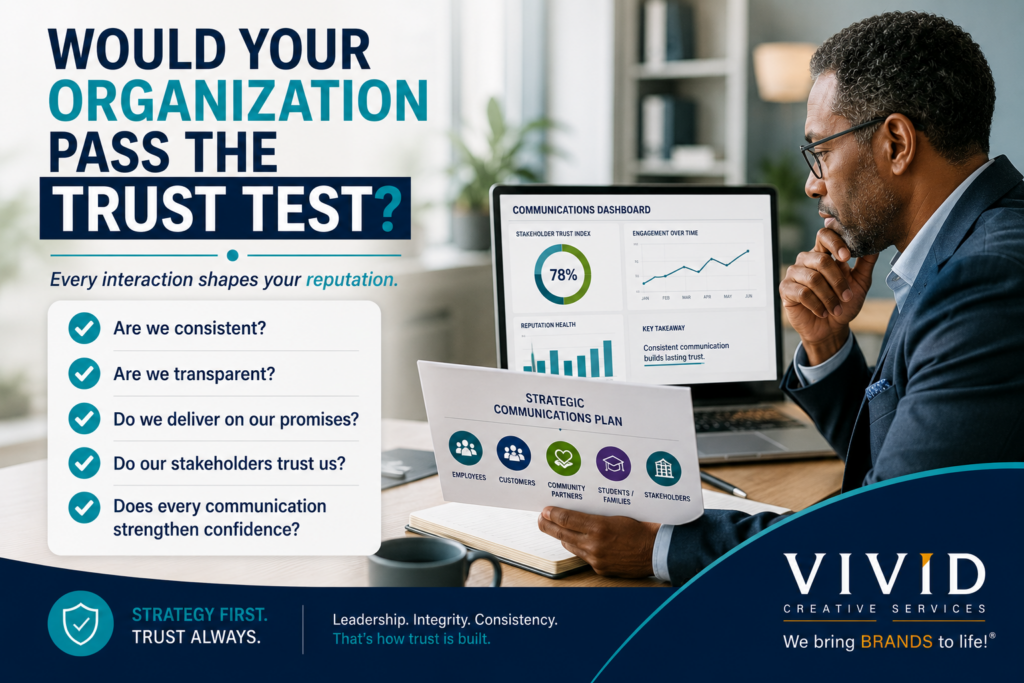
The VCS Perspective
At Vivid Creative Services, we’ve never believed communication exists simply to inform people. We believe communication exists to strengthen relationships.
Over the past 25 years, we’ve had the privilege of working alongside organizations of all sizes and across multiple industries. While every organization faces unique challenges, one pattern continues to emerge.
The organizations that experience sustainable growth aren’t always the loudest.
They aren’t always the largest. They aren’t always the organizations with the biggest marketing budgets.
They’re the organizations that consistently earn trust. They make promises—and keep them. They communicate honestly—even when the message is difficult. They listen before responding. They invest in relationships before seeking recognition. They understand that every conversation contributes to their reputation.
That’s why our Strategy First philosophy begins long before marketing tactics are discussed.
We start by asking deeper questions.
- What do you want your organization to be known for?
- What promises are you making to your stakeholders?
- Do your communications consistently reinforce those promises?
Because when communication and organizational behavior align, something powerful happens. Trust grows. Relationships deepen. Communities respond. Employees engage.
Customers remain loyal. Partners invest. And growth becomes more sustainable.
From our perspective, strategic communications has never been about saying more. It’s about consistently communicating what matters most.
Trust Is Earned One Conversation at a Time
Every organization communicates. The question is whether those communications consistently strengthen trust.
Long before someone becomes a customer, donor, patient, student, partner, volunteer, or advocate, they’re forming opinions about your organization.
They’re evaluating every interaction. Every email, meeting, social media post, news story and every conversation with an employee. Every experience either strengthens confidence or quietly weakens it. That’s why trust should never be viewed as a marketing outcome.
It’s an organizational asset built through intentional leadership and reinforced through strategic communications.
The organizations that thrive over the long term understand this simple truth: Trust isn’t created by one exceptional campaign. It’s earned through thousands of consistent moments that reflect integrity, transparency, reliability, and authentic leadership.
Those moments become your reputation. And your reputation becomes one of your greatest competitive advantages.
Continue The Series
This article is part of our four-part executive series:
- Story 1: Before You Seek Publicity, Build a Strategic Communications Strategy (Link)
- Story 2: How to Earn Media Coverage Without a Big PR Budget (Link)
- Story 3: Building Brand Trust Through Strategic Communications (Current Article)
The next question every leader should ask is: How do we protect that trust when our organization faces unexpected challenges? Continue with the final article in this executive series: Story 4: Protecting Your Reputation Before a Crisis Happens (Link). Discover why the strongest crisis communications plans are built long before a crisis occurs—and how organizations with established trust recover faster, communicate more effectively, and emerge even stronger when difficult situations arise.
Ready to Build a Brand People Trust?
Visibility may introduce your organization to new audiences. Trust is what turns awareness into lasting relationships.
At Vivid Creative Services, we help businesses, nonprofit organizations, educational institutions, healthcare organizations, government agencies, and professional service firms develop Strategy First communications that strengthen credibility, align leadership, and build meaningful connections with the people who matter most.
If your organization is ready to move beyond disconnected marketing activities and begin building trust through intentional strategic communications, we’d welcome the opportunity to start the conversation. Let’s chat (Link)!
Because the strongest brands aren’t simply recognized. They’re trusted.