


Why Every Organization Needs a Communications Strategy Before Chasing Media Coverage
The Vivid Perspective: Insights on Branding, Marketing & Storytelling; Strategic Communications: Building Visibility, Credibility & Trust; Story 1 of 4
Quick Answer
If you only have two minutes, here’s the takeaway.
Strategic communications is the intentional process of aligning every organizational message with your mission, value, organizational philosophy, business goals, brand promise, and stakeholder expectations. It ensures that your brands, marketing, public relations, leadership communications, website, social media, customer experience, community engagement, and internal communications all tell the same story.
Many organizations believe they have a visibility problem when they actually have a strategy problem. They pursue publicity before determining what they want to be known for, who they need to reach, and how success should be measured. As a result, their communications become reactive, inconsistent, and less effective.
Before investing more time or money into media outreach, advertising, content creation, or social media, leaders should first develop a communications strategy that answers three essential questions:
- What reputation are we intentionally building?
- Who are the audiences that matters most?
- How should every communication reinforce our mission and strategic goals?
When strategy comes first, every communication works harder to build visibility, credibility, and trust.
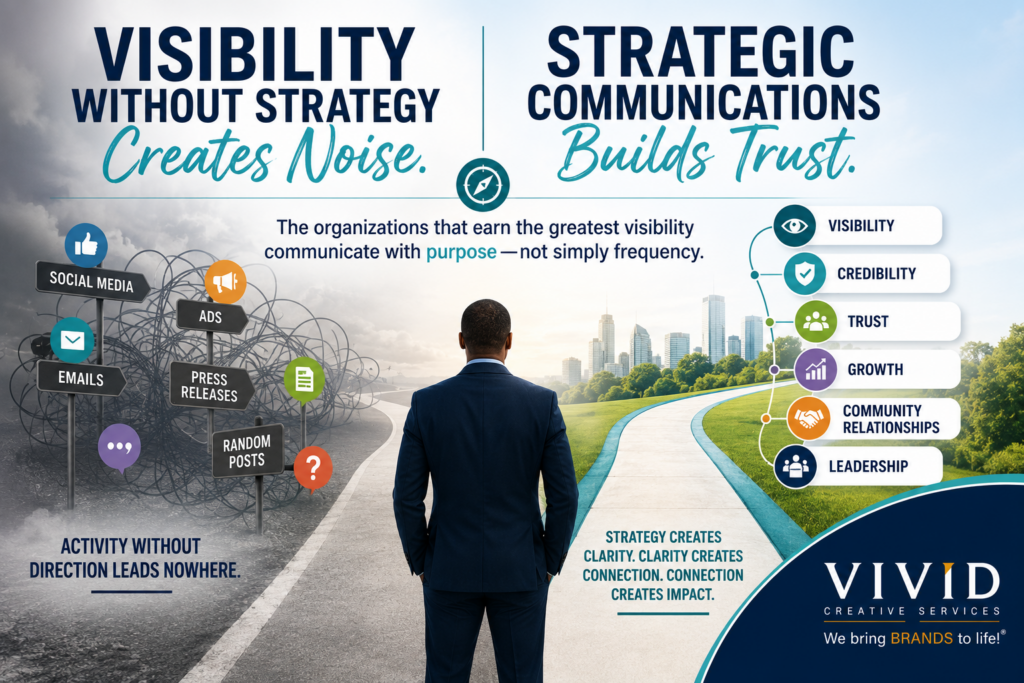
The Organizations People Trust Don’t Communicate More—They Communicate Better
Every organization wants to be recognized, respected, and remembered. Business owners hope prospective customers choose them over competitors. Nonprofit leaders want donors, volunteers, and community partners to understand their mission and impact. Educational institutions strive to build confidence with prospective families and stakeholders, while healthcare organizations work to earn patient trust long before the first appointment. Regardless of industry, one goal remains the same: building meaningful relationships that lead to long-term success.
Yet many organizations make the same costly mistake. They invest in marketing campaigns, publish press releases, launch social media initiatives, and pursue media coverage without first establishing a strategic communications plan. When results fall short, the instinct is often to increase activity rather than examine the underlying strategy. More posts, more emails, more advertising, or more public relations rarely solve the problem if every communication lacks a clear purpose and consistent direction.
Strategic communications is not about saying more, it is about saying the right things to the right people at the right time through the right channels. Organizations that consistently build visibility, credibility, and trust rarely communicate more than everyone else. Instead, they communicate with greater intention. Every message reinforces their mission, supports their organizational goals, and strengthens relationships with the audiences that matter most.
Whether you lead a growing business, a nonprofit organization, a healthcare practice, a school, a government agency, or a professional services firm, strategic communications is no longer optional. In today’s connected world, every interaction shapes your reputation. Before pursuing publicity, organizations must first build the strategy that gives every communication purpose, consistency, and measurable impact.
Why Strategic Communications Matters More Than Ever
Today’s audiences have more choices, more information, and higher expectations than ever before. Customers research organizations before making purchases. Donors evaluate nonprofit transparency before contributing. Parents compare schools online before scheduling tours. Patients read reviews before selecting healthcare providers. Investors, partners, board members, employees, and community stakeholders all form opinions long before speaking with someone from your organization.
Every one of those touchpoints is communication.
- Your website communicates.
- Your leadership communicates.
- Your employees communicate.
- Your customer service communicates.
- Your social media communicates.
- Your community involvement communicates.
- Even your silence communicates.
The question is not whether your organization is communicating. The question is whether those communications are intentional, aligned, and advancing your strategic objectives.
Organizations that approach communications strategically create a consistent experience regardless of where someone encounters their brand. Their messaging feels authentic because it reflects who they are, what they value, and how they deliver on their promises. Over time, this consistency builds familiarity, confidence, and trust—the foundation of every strong relationship.
By contrast, organizations without a communications strategy often send mixed messages. Marketing promotes one priority while leadership emphasizes another. Employees describe services differently than the website. Community outreach highlights initiatives that never appear on social media. Media opportunities are pursued without clear messaging, resulting in inconsistent public perception. None of these issues stem from a lack of effort; they stem from a lack of alignment.
Before leaders can improve visibility or generate positive publicity, they must first recognize the organizational challenges that strategic communications is designed to solve.
Eight Signs Your Organization Needs a Strategic Communications Strategy
Many organizations assume their communications are working simply because they are busy producing content. Activity, however, is not the same as effectiveness. If any of the following challenges sound familiar, it may be time to step back and develop a more intentional communications strategy.
1. You’re Always Reacting Instead of Planning
Does your team constantly scramble to respond to deadlines, community events, media inquiries, or social media trends? Reactive communication often leads to inconsistent messaging, missed opportunities, and unnecessary stress. Strategic organizations operate from a proactive communications calendar aligned with business objectives rather than reacting to whatever happens next.
2. Different People Tell Different Stories
Ask five employees to describe your organization, and do you receive five different answers? Inconsistent messaging confuses customers, donors, families, partners, and stakeholders. Strategic communications creates a shared narrative that every employee, board member, and leader can confidently communicate.
3. Your Marketing Feels Busy but Doesn’t Produce Results
Many organizations confuse marketing activity with marketing effectiveness. Publishing blog posts, sending newsletters, posting on social media, and attending community events all require significant effort. Without a guiding strategy, however, these activities often operate independently rather than reinforcing one another. Strategic communications ensures every activity supports a common purpose.
4. You Struggle to Explain What Makes Your Organization Different
If prospective customers, donors, or partners cannot quickly understand your unique value, your communications are likely emphasizing services rather than outcomes. Strategic communications helps organizations clearly articulate their mission, impact, expertise, and competitive advantages in ways that resonate with their audiences.
5. Leadership Isn’t Fully Aligned
When executives, department leaders, marketing teams, and frontline employees communicate different priorities, organizational credibility begins to erode. Strategic communications aligns leadership around shared messaging, strategic priorities, and organizational goals before those messages reach external audiences.
6. You Only Think About Public Relations When You Need Publicity
Too often, organizations contact the media only when they have an announcement to make. Effective public relations begins long before a press release is written. Building relationships with journalists, community partners, industry leaders, and stakeholders requires consistent engagement over time. Strategic communications creates those relationships before they become necessary.
7. Your Reputation Depends on Chance
Reputation should never be accidental. Every customer interaction, community partnership, employee experience, and leadership decision contributes to public perception. Organizations that intentionally manage these experiences build stronger reputations than those that simply hope positive experiences speak for themselves.
8. Success Is Difficult to Measure
One of the clearest signs of an absent communications strategy is the inability to define success. Are you measuring awareness? Engagement? Website traffic? Community partnerships? Donor retention? Referral growth? Media coverage? Without clearly defined objectives, communications become difficult to evaluate and even harder to improve.
Executive Insight
One of the greatest misconceptions about communications is that visibility creates credibility. In reality, the opposite is often true. Organizations that consistently earn visibility typically do so because they have already established credibility through clear messaging, authentic relationships, and purposeful communication. Publicity amplifies trust—it rarely creates it on its own.
From Communication Activity to Communication Strategy
Every organization communicates. The difference is whether those communications happen intentionally or accidentally.
Many leaders assume that strategic communications is simply another name for public relations or marketing. While those disciplines certainly play important roles, strategic communications is much broader. It provides the direction that informs every message, every conversation, every campaign, and every relationship your organization builds.
Think of it this way….
- Marketing promotes your products, services, and opportunities.
- Public relations builds relationships with external audiences.
- Branding shapes how people perceive your organization.
- Customer service reinforces your promises through everyday experiences.
- Internal communications align employees around a common vision.
- Strategic communications serves as the thread that connects them all into one cohesive story.
When organizations communicate strategically, every interaction supports the same organizational goals. Whether someone reads your website, attends a community event, speaks with an employee, receives an email newsletter, or sees your CEO interviewed on the local news, they experience a consistent brand that reflects the same mission, values, and promise.
If strategic communications is the foundation, leaders need a practical framework to guide every communication decision.
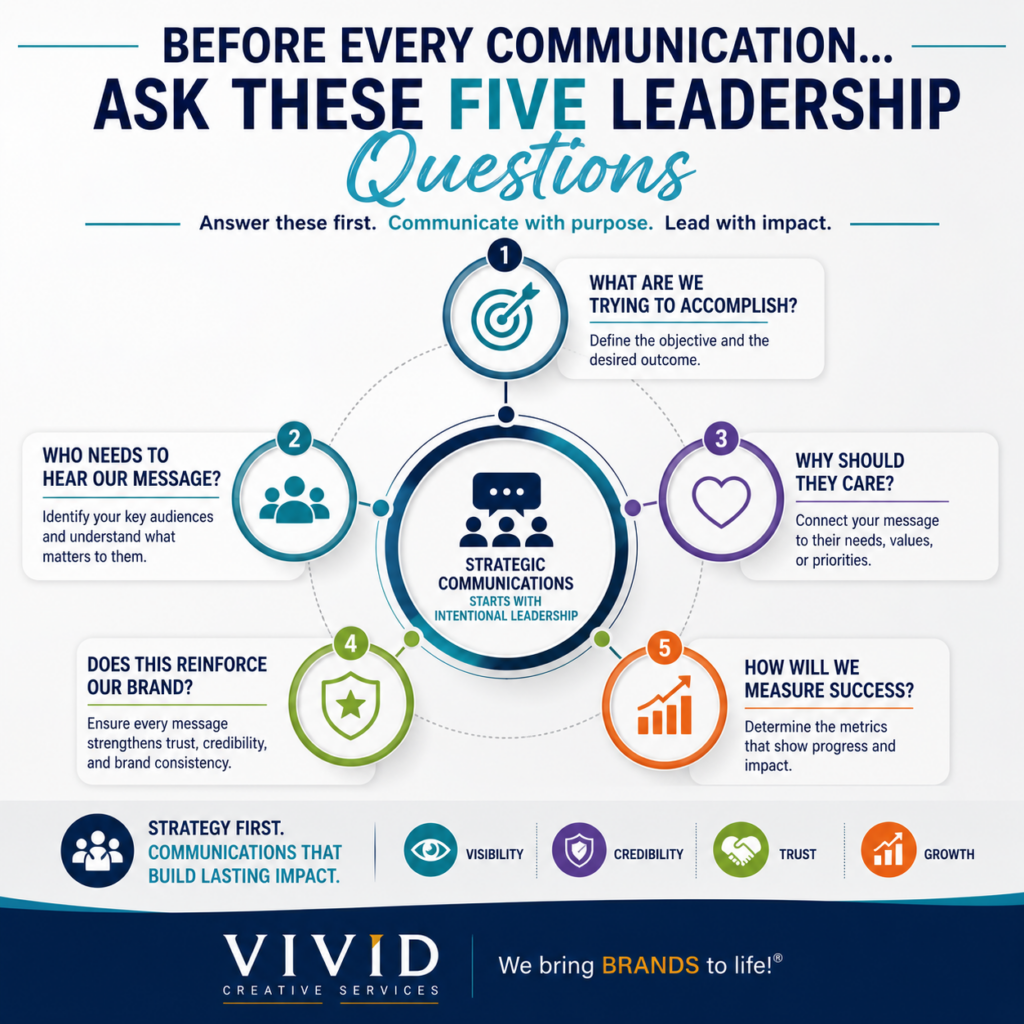
The VCS Communications Compass™
At Vivid Creative Services, we believe effective communications begin with clarity—not activity. Before developing campaigns or pursuing media coverage, leaders should evaluate every communication through six strategic questions. Together, these questions form what we call the VCS Communications Compass™, a simple framework for building visibility, credibility, and trust with intention.
Vision: What Are We Trying to Accomplish?
Every communication should support a larger organizational objective. Are you increasing awareness? Strengthening community relationships? Recruiting students or employees? Building donor confidence? Expanding into new markets? Attracting strategic partners? Without a clearly defined destination, communications become disconnected activities rather than coordinated efforts that move the organization forward.
Audience: Who Needs to Hear Our Story?
Not every audience requires the same message. Customers, donors, patients, parents, employees, board members, community leaders, elected officials, referral partners, and media outlets each have different needs, expectations, and motivations. Strategic organizations prioritize their audiences and tailor communications without compromising their core message.
Story: Why Should People Care?
Many organizations communicate what they do. Far fewer communicate why it matters.
Facts inform. Stories connect.
Rather than announcing activities, strategic communicators demonstrate impact. They highlight real people, measurable outcomes, meaningful partnerships, and community transformation. The most memorable organizations are rarely those with the largest budgets; they are the ones with the clearest stories.
Consistency: Does Every Message Reinforce Our Brand?
Trust is built through repetition. Every communication should reinforce the same mission, personality, values, and promise. When departments communicate independently without shared messaging, confusion replaces confidence. Consistency does not mean repeating identical language; it means reinforcing the same strategic story across every communication channel.
Relationships: Who Are We Investing In Before We Need Them?
Strong communications extend beyond broadcasting information. They build relationships.
- Journalists
- Community partners
- Industry associations
- Business leaders
- Elected officials
- Volunteers
- Donors
- Customers
- Employees
Organizations that invest in these relationships consistently earn greater trust than those who only reach out when they need publicity or support.
Results: How Will We Measure Success?
Strategic communications should contribute to measurable organizational outcomes. Success may include increased awareness, stronger community partnerships, improved donor retention, higher enrollment, increased patient inquiries, stronger employee engagement, or greater referral activity. The specific metrics matter less than ensuring communications are evaluated against meaningful business objectives rather than simply counting impressions or likes.
Executive Insight
Communication should never be viewed as a department responsibility—it is a leadership responsibility. Every strategic decision eventually becomes a communication decision, and every communication influences how stakeholders perceive the organization. Make sure that the communicators are at the table when strategic decisions are made. Leaders who recognize this connection build stronger organizations because they manage both operations and reputation with equal intentionality.
Strategic Communications Looks Different Across Every Organization
Although the principles remain the same, the application of strategic communications varies depending on your mission, audience, and goals.
For Small and Mid-Sized Businesses
Customers have countless choices. Strategic communications helps businesses articulate why they are different, communicate consistent value, and establish credibility that larger competitors cannot easily replicate. Visibility becomes a competitive advantage when supported by authentic relationships and a compelling story.
For Private Equity-Backed Companies
Growth often happens quickly, bringing acquisitions, organizational change, and increased stakeholder expectations. Strategic communications align leadership, employees, investors, customers, and partners during periods of transformation, helping maintain confidence while supporting long-term enterprise value.
For Professional Service Firms
Attorneys, accountants, consultants, architects, and financial advisors rarely compete on price alone. Trust is their greatest asset. Strategic communications positions professionals as knowledgeable advisors through thought leadership, educational content, speaking engagements, and consistent relationship building that naturally generates referrals.
For Nonprofit Organizations
Donors don’t invest in organizations—they invest in impact. Strategic communications helps nonprofits demonstrate measurable outcomes, celebrate community partnerships, strengthen donor confidence, and tell stories that inspire continued engagement long after a fundraising campaign concludes.
For Educational Institutions
Parents, students, faculty, staff, alumni, and community stakeholders all evaluate schools differently. Strategic communications aligns enrollment marketing, internal communications, community engagement, and leadership messaging into one unified story that builds confidence and reinforces educational excellence.
For Healthcare Organizations
Trust begins long before a patient schedules an appointment. Strategic communications helps healthcare organizations educate communities, strengthen physician reputations, communicate patient-centered care, and build confidence through transparency, expertise, and compassionate storytelling.
For Government Agencies
Government communication extends beyond sharing information. It builds public confidence, demonstrates accountability, encourages civic engagement, and helps communities understand the impact of public programs and investments. Strategic communications supports transparency while strengthening relationships between agencies and the citizens they serve.
A Real-World Example: Why Strategy Outperforms Activity
Imagine two nonprofit organizations preparing to launch similar community initiatives.
The first organization immediately creates flyers, posts on social media, writes a press release, and sends emails announcing the program. While these tactics generate some awareness, the messaging varies across channels, the stories focus primarily on organizational activities, and little attention is given to why the initiative matters to the community.
The second organization begins differently. Leadership first defines the initiative’s purpose, identifies key audiences, develops a consistent message, gathers participant success stories, equips board members and staff with talking points, establishes media relationships, and creates a communications calendar that coordinates outreach across multiple channels. By the time the program launches, every communication reinforces the same strategic narrative.
Both organizations invested time and resources into communications. Only one invested in strategy first.
The difference isn’t simply more publicity, it’s greater clarity, stronger relationships, and a more credible reputation that continues to generate opportunities long after the initial announcement.
Understanding the framework is only the beginning. The next step is translating strategic communications into practical leadership actions that can strengthen your organization immediately.

Leadership Action Plan: Five Steps to Strengthen Your Strategic Communications
Strategic communications does not require a larger budget to begin. Strategic communications requires stronger leadership, greater alignment, and a commitment to communicating with intention. Whether your organization has a dedicated communications team or relies on a small staff wearing multiple hats, these five actions can help establish a stronger foundation.
1. Clarify What You Want to Be Known For
Every organization develops a reputation—whether by design or by default. Leadership should intentionally define the organization’s desired reputation before developing campaigns or communications. Ask yourself:
- What do we want our organization to be known for?
- What promises do we consistently make?
- What experience do we want every stakeholder to have?
The answers become the foundation for every future communication.
2. Identify Your Most Important Audiences
Not every audience requires the same information or level of engagement. Prioritize the stakeholders who have the greatest influence on your organization’s success. Customers, donors, employees, parents, patients, referral partners, elected officials, volunteers, and community leaders each require thoughtful, relevant communication that reflects their unique interests while remaining true to your organization’s mission.
3. Audit Every Communication Channel
Review your website, social media, printed materials, presentations, newsletters, email signatures, recruiting materials, leadership messaging, and community outreach. Do they consistently communicate the same mission, values, and organizational story? Inconsistencies often reveal opportunities to strengthen credibility and improve the overall stakeholder experience.
4. Create a Strategic Communications Calendar
Organizations that communicate with purpose rarely operate without a plan. Develop an annual communications calendar that aligns with organizational priorities, major initiatives, seasonal opportunities, community events, fundraising campaigns, recruitment efforts, and leadership announcements. Planning ahead allows your team to communicate proactively rather than constantly reacting to immediate needs.
5. Measure Outcomes—Not Just Activity
Communication success extends beyond counting followers, impressions, or website visits. Evaluate how communications contribute to meaningful organizational objectives, such as stronger community partnerships, increased donor retention, higher enrollment, improved patient acquisition, employee engagement, customer loyalty, or qualified business inquiries. Strategic communications should support measurable organizational growth, not simply generate more content.
Micro FAQ
What is strategic communications?
Strategic communications is the intentional planning, development, and delivery of messages that support an organization’s mission, business objectives, and stakeholder relationships. It integrates marketing, public relations, leadership communications, branding, and community engagement into one coordinated strategy.
How is strategic communications different from public relations?
Public relations focuses primarily on managing relationships with external audiences and the media. Strategic communications is broader. It aligns every internal and external communication—including marketing, leadership messaging, employee communications, customer experience, and public relations—with the organization’s overall strategic goals.
Do small organizations really need a communications strategy?
Absolutely. Smaller organizations often have fewer resources, making strategic communication even more important. A clear strategy ensures limited time and budgets are invested in activities that create the greatest impact and support long-term growth.
Who should own strategic communications?
While communications professionals often coordinate implementation, leadership owns the strategy. Executives establish organizational priorities, define the desired reputation, and ensure every department communicates consistently in support of those goals.
How often should a communications strategy be reviewed?
Organizations should review their communications strategy annually and revisit it whenever significant organizational changes occur, such as leadership transitions, strategic planning initiatives, mergers, new services, expansion, or major community events.
Can strategic communications improve organizational reputation?
Yes. Consistent, transparent, and purposeful communication builds credibility over time. When organizations communicate with intention and deliver on their promises, they earn trust that strengthens relationships with customers, donors, employees, partners, and the communities they serve.
The VCS Perspective
Many organizations believe communications begins with writing a press release, launching a campaign, or publishing content on social media. In reality, effective communications begins much earlier—with leadership deciding what the organization stands for, who it serves, and how every interaction should reinforce that purpose.
At Vivid Creative Services, we believe organizations achieve greater visibility not because they communicate more frequently, but because they communicate more intentionally. Strategy provides the clarity that guides every message, every relationship, and every opportunity to build trust. When communications aligns with organizational goals, marketing becomes more effective, public relations becomes more authentic, leadership becomes more credible, and every stakeholder interaction becomes an opportunity to strengthen your brand.
Our philosophy is simple: Be clear. Be concise. Be compelling. Be colorful. Those four principles help organizations transform communication from a collection of disconnected activities into a strategic advantage that supports sustainable growth and meaningful relationships.
Your Reputation Is Built One Conversation at a Time
Every organization communicates. The only question is whether those communications are shaping your future intentionally or leaving your reputation to chance.
Strategic communications is not reserved for large corporations with dedicated public relations departments. It is a leadership discipline that helps organizations of every size build visibility, strengthen credibility, and earn lasting trust. By beginning with strategy instead of tactics, leaders create a strong foundation that allows every campaign, conversation, partnership, and media opportunity to reinforce the same compelling story.
Before pursuing your next marketing campaign, scheduling another social media post, or reaching out to the media, pause and ask a more important question: Does every communication move our organization closer to the reputation we want to build?
When the answer is yes, every communication becomes an investment in your organization’s future.
Ready to Build a Strategic Communications Strategy?
Building visibility, credibility, and trust doesn’t happen by accident—it happens through intentional leadership and a clear communications strategy.
If your organization is ready to move beyond reactive marketing and develop a communications strategy aligned with your mission and business goals, now is the perfect time to start.
At Vivid Creative Services, our Strategy First approach helps organizations clarify their message, align their communications, and create a practical roadmap for long-term growth. Whether you lead a business, nonprofit, school, healthcare organization, professional services firm, or government agency, investing in strategic communications today will help strengthen every relationship you build tomorrow. Let’s chat so we can help you launch your strategy (Link)
Because the organizations that communicate with the greatest intention are often the organizations that create the greatest impact.
Continue Your Executive Learning Journey
You’ve taken the first step toward building a stronger communications strategy by understanding why strategic communications should precede publicity. Now discover how to turn that strategy into greater visibility. Continue to Story 2, How to Earn Media Coverage Without a Big PR Budget (Link). Learn why meaningful media coverage isn’t purchased—it’s earned. Discover what journalists are really looking for, what makes a story newsworthy, and six Strategy First approaches to building relationships, credibility, and community visibility without relying on a large public relations budget.