
The Vivid Perspective Series: Insights on Branding, Marketing & Storytelling; Marketing Leadership for Growth: How Smart Organizations Scale with Strategy, Not Just Execution; Part 1 of 4
Most Organizations Don’t Have a Marketing Problem — They Have a Leadership Gap
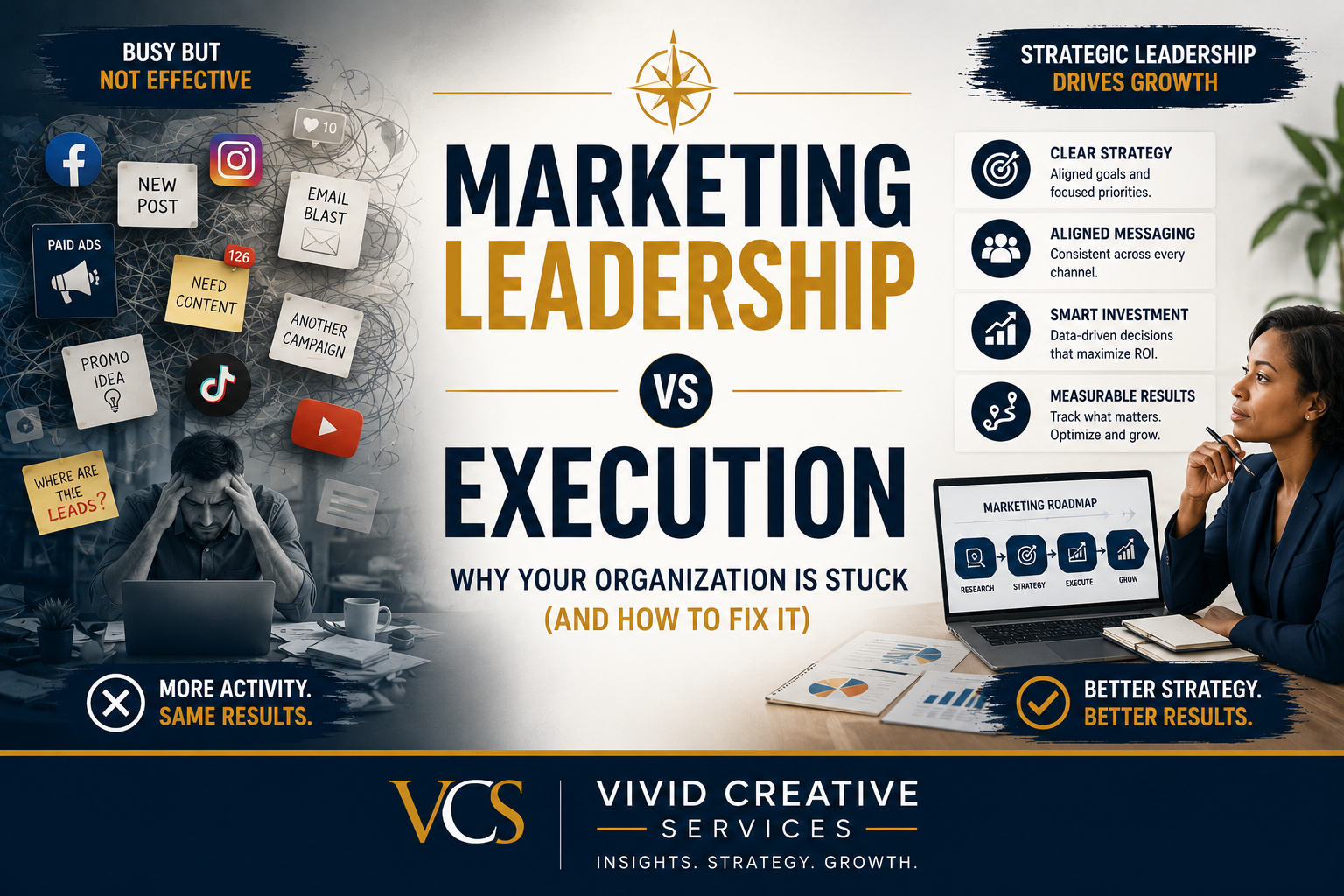
Most organizations believe their marketing challenges stem from limited budgets, lack of time, or inconsistent execution. However, after working with businesses, non-profits, healthcare organizations, and public institutions for over two decades, a different pattern emerges—one that is far more foundational. The real issue is not effort; it is the absence of clear marketing leadership. Teams are busy, campaigns are launched, and content is created, yet results remain inconsistent or underwhelming. This happens because activity without direction rarely produces meaningful growth. When marketing lacks leadership, it becomes reactive, fragmented, and disconnected from business goals. Understanding this distinction is the first step toward transforming marketing from a cost center into a growth driver.
Who This Matters For: Organizations Ready to Move from Activity to Growth
This conversation is especially relevant for organizations navigating growth, transition, or increased competition. Whether you are a small business under $10 million in revenue, a private equity-backed company scaling operations, a nonprofit seeking stronger donor engagement, or a healthcare provider aiming to increase patient acquisition, the challenge is often the same. Marketing exists—but it is not fully aligned with leadership priorities. Professional service firms, educational institutions, and government agencies frequently experience this gap as well, particularly when internal teams are stretched thin or operating without a unified strategy. The reality is simple: as organizations grow, the complexity of marketing increases, and leadership becomes essential. Without it, even the most talented teams struggle to produce consistent results. Recognizing that you are not alone in this challenge creates the opportunity to address it with clarity and confidence.
Marketing Execution vs Marketing Leadership: Understanding the Difference
To move forward, it is important to clearly distinguish between marketing execution and marketing leadership. Execution is tactical, it includes managing social media, running ads, sending emails, updating websites, and producing content. These activities are necessary, but they are not sufficient on their own. Marketing leadership, on the other hand, is strategic. It defines the direction, aligns efforts with business goals, prioritizes initiatives, and ensures that every action contributes to measurable outcomes. Without leadership, execution becomes a series of disconnected tasks that may look productive but fail to deliver meaningful impact. With leadership, execution becomes focused, intentional, and results-driven. Organizations that understand this difference are better equipped to allocate resources effectively and make smarter decisions about where to invest their time and budget.
The Hidden Cost of Operating Without Marketing Leadership
When marketing operates without leadership, the consequences are often subtle at first but become increasingly costly over time. Teams may experience burnout from constantly reacting to new ideas or urgent requests without a clear plan. Budgets are spent on tactics that do not align with long-term goals, leading to poor returns on investment. Messaging becomes inconsistent, confusing the audience and weakening brand credibility. Opportunities are missed because there is no clear framework for prioritization or decision-making. Perhaps most importantly, leadership teams lose confidence in marketing because results feel unpredictable. These hidden costs accumulate, creating a cycle where organizations invest more effort but see diminishing returns. Breaking this cycle requires a shift from doing more marketing to leading marketing more effectively.
25 Questions Leaders Ask When Marketing Isn’t Working
When organizations begin to recognize that something is off in their marketing, the same questions tend to surface. Leaders often ask: Why aren’t our campaigns producing results? Are we reaching the right audience? Is our messaging clear and compelling? How do we measure success? Are we investing in the right channels? Why does our marketing feel inconsistent? Do we need more staff, or better strategy? How do we prioritize what matters most? Are we aligned internally? Why does growth feel harder than it should? These questions are not signs of failure—they are signals that leadership is needed. Addressing these challenges requires more than quick fixes; it requires a structured, strategic approach that brings clarity to complexity. When these questions are answered through leadership, organizations gain confidence and direction.
What This Looks Like in the Real World
Consider a growing professional services firm that invests heavily in digital marketing but struggles to convert leads into clients. Their team is actively posting content, running ads, and updating their website—but results remain inconsistent. After stepping back to assess the situation, it becomes clear that there is no unified strategy guiding these efforts. Messaging varies across platforms, target audiences are not clearly defined, and success metrics are unclear. Once marketing leadership is introduced, the focus shifts from activity to alignment. The firm defines its ideal client, clarifies its value proposition, and prioritizes high-impact initiatives. Within months, marketing becomes more focused, lead quality improves, and conversion rates increase. This example illustrates how leadership transforms effort into effectiveness.
Why Marketing Leadership Drives Sustainable Growth
Sustainable growth does not come from isolated campaigns or short-term tactics; it comes from consistent, strategic alignment over time. Marketing leadership ensures that every initiative supports broader business objectives, creating a cohesive and intentional approach to growth. It enables organizations to anticipate challenges, adapt to changes in the market, and make informed decisions based on data and insights. Leadership also fosters accountability, ensuring that marketing efforts are measured and optimized continuously. This creates a cycle of improvement where each initiative builds on the last, strengthening the overall strategy. Organizations that prioritize marketing leadership are better positioned to achieve long-term success because they operate with clarity, focus, and purpose.
How The Vivid Journey™ Brings Clarity to Your Marketing
One of the most effective ways to understand where your marketing is working—and where it is breaking down—is through a clear, structured framework. This is exactly where The Vivid Journey™ provides value. Rather than leaving marketing to chance, this framework outlines the natural progression every customer takes: from becoming aware of your brand (Know), to building interest (Like), developing confidence (Trust), taking action (Try & Buy), and ultimately becoming loyal advocates (Repeat & Refer). When this journey is clearly defined, marketing becomes more intentional, consistent, and aligned with how people actually make decisions.
Most organizations struggle not because their customer journey is flawed, but because it is undefined or inconsistently applied. Many invest heavily in visibility—social media, advertising, and content—yet fail to guide their audience beyond awareness. Others focus on conversion without first building trust, creating friction in the decision-making process. Without a clear framework, marketing efforts become fragmented, and opportunities to build meaningful relationships are missed. The result is activity without progression.
The Vivid Journey™ solves this by bringing structure and clarity to every stage of the customer experience. It helps organizations identify where they are, where gaps exist, and how to move their audience forward with intention. Instead of guessing what to do next, leaders can make informed decisions that align with both customer behavior and business goals. When applied correctly, the framework transforms marketing from a series of disconnected efforts into a cohesive, strategic system designed for growth.
How to Begin Shifting from Execution to Leadership
Transitioning from execution-focused marketing to leadership-driven marketing does not require a complete overhaul—it begins with a shift in perspective. Start by evaluating whether your current efforts are aligned with your business goals. Identify gaps in strategy, messaging, and measurement. Clarify who is responsible for guiding marketing decisions and ensuring alignment across initiatives. Establish clear priorities and focus on high-impact activities rather than trying to do everything at once. Most importantly, commit to making decisions based on data and insights rather than assumptions. This shift creates a foundation for more effective marketing and sets the stage for long-term growth.
Your Score Tells a Story: Are You Leading or Reacting?
At this point, the most important question is not how much marketing you are doing, but how well it is being led. If your efforts feel scattered, inconsistent, or difficult to measure, it may be time to take a closer look at your approach. This is where clarity becomes essential. Understanding your current position allows you to make informed decisions about where to go next. Without this clarity, it is easy to continue investing time and resources without seeing meaningful results. Taking a moment to assess your marketing leadership can provide the insight needed to move forward with confidence.
Take the Next Step Toward Marketing Clarity and Growth
If you are ready to move from uncertainty to clarity, the next step is simple. Start by completing the Marketing Leadership Scorecard to evaluate where your organization stands (Click here). This quick assessment will help you identify strengths, uncover gaps, and gain a clearer understanding of what needs to change. From there, consider scheduling a Marketing Leadership Discovery Session with Vivid Creative Services (Click here). Together, we can explore your goals, assess your current strategy, and outline a path forward that aligns with your vision for growth. Marketing does not have to feel overwhelming or unpredictable. With the right leadership, it becomes a powerful driver of success.
MICRO FAQ
What is marketing leadership?
Marketing leadership is the strategic oversight that aligns marketing efforts with business goals, ensuring clarity, consistency, and measurable results.
What is the difference between marketing strategy and execution?
Strategy defines direction and priorities, while execution involves carrying out specific tactics like campaigns and content.
Why does marketing fail in small organizations?
Marketing often fails due to a lack of leadership, unclear strategy, inconsistent messaging, and poor measurement.
Do I need a marketing leader if I already have a team?
Yes, teams need leadership to ensure alignment, prioritization, and effectiveness.
What is a Fractional CMO?
A Fractional CMO is an experienced marketing leader who provides strategic oversight on a part-time or contract basis, helping organizations scale without hiring full-time.