
The Vivid Perspective Series, Digital Marketing Strategies 2026; Part 2 of 4
When Social Media Feels Exhausting, It’s Usually a Sign of One Thing
A small business owner recently confessed during a strategy session: “We post everywhere. We’re exhausted. And nothing is working.”
A nonprofit leader echoed the same frustration: “Our board wants us active on five platforms… but we don’t have a staff of five.”
And a school communications director added: “We’re spending more time creating content than actually connecting with families.”
This isn’t a coincidence.
Today’s social media landscape overwhelms organizations because it seems like the rules keep changing, platforms keep shifting, and algorithms keep demanding more. But here’s the truth most small organizations don’t realize:
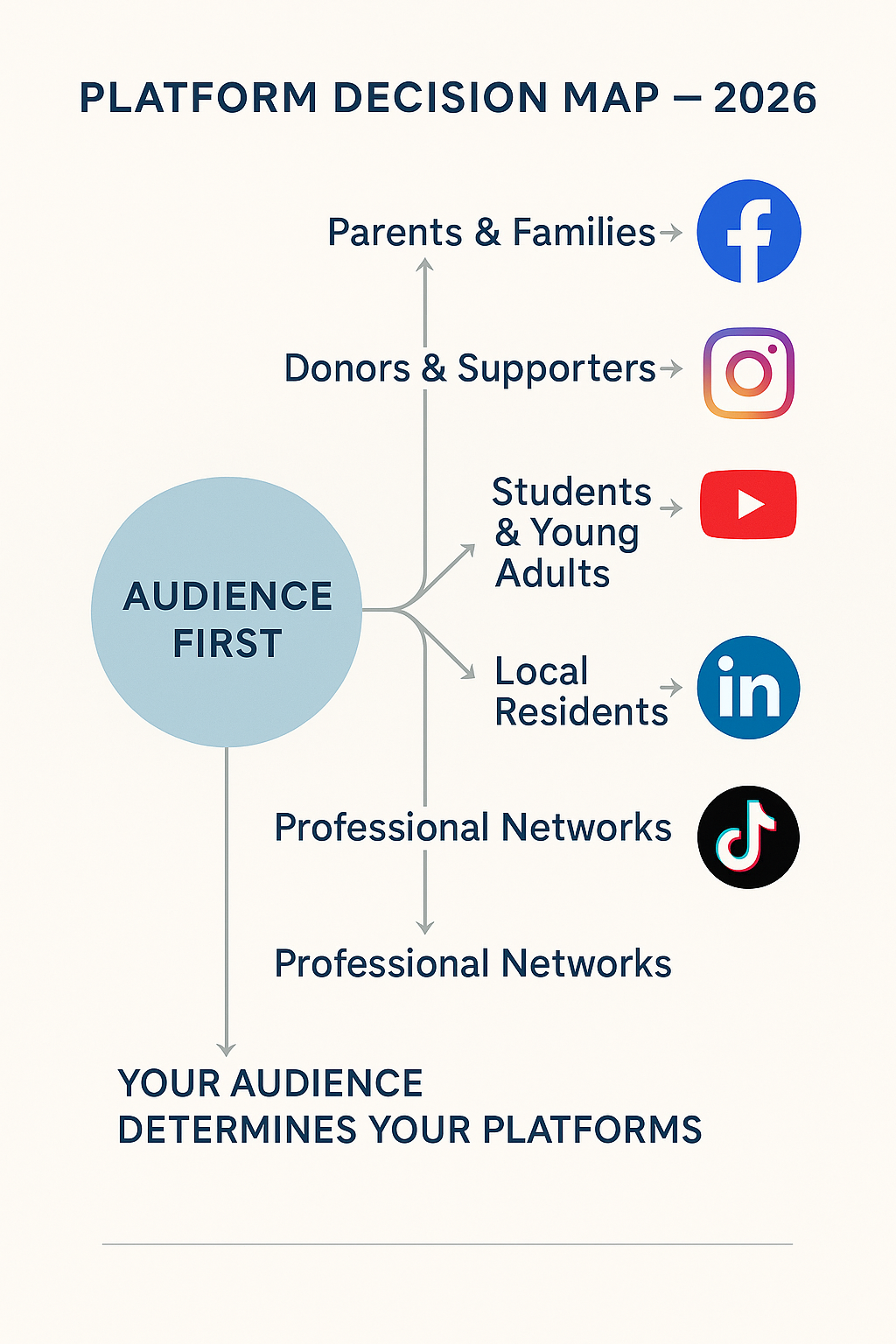
You don’t need to post everywhere. You only need to post where your audience is.
The key to success in 2026 is not volume. It’s alignment.
This story removes the guesswork by showing small businesses, nonprofits, schools, and local government agencies exactly which platforms matter, why they matter, and how to use them strategically without burning out your team.
Let’s build clarity — and stop letting social media control your time, energy, and creativity.
The Social Media Shift in 2026 — Why Organizations Must Rethink Their Strategy
Social media has undergone a seismic shift. In 2026:
- Organic reach is harder — unless content is deeply relevant.
- Short-form video is the most consumed digital format.
- AI-driven feeds prioritize personalized, helpful content.
- Users now search inside platforms (Instagram, TikTok, YouTube) as much as on Google.
- Every audience has platform-specific habits — and they rarely overlap.
This means the old strategy of “post on all platforms” no longer works. Organizations with small teams must focus on the right platforms, not all platforms.
Here’s the guiding principle: The platforms your audience uses determine where you should be.
Not algorithms. Not trends. Not pressure.
When you know where your audience lives digitally, everything becomes easier:
- Engagement improves
- Content becomes more meaningful
- Team workload decreases
- Results become measurable
This is the power of an aligned social media strategy.
The Top 25 Social Media Questions Organizations Ask in 2026
These questions were collected from small businesses, nonprofits, schools, and civic agencies nationwide — and represent the highest-search-intent queries for social media strategy in 2026.
1. Which social media platforms matter most in 2026?
Answer: Facebook, Instagram, YouTube, LinkedIn, and TikTok (when serving younger audiences) are the most relevant platforms for organizations in 2026.
Micro-Story: A St. Louis tutoring program tripled enrollments simply by focusing on Facebook (for parents) and Instagram (for teens).
2. Do small organizations need to be on every platform?
Answer: No. Most organizations only need 2–3 platforms based on audience behavior.
Micro-Story: A nonprofit stopped posting on TikTok and Pinterest — and their Facebook engagement doubled.
3. What is the best platform for local businesses?
Answer: Facebook for community reach and Instagram for visual storytelling.
4. What is the best platform for nonprofits?
Answer: Facebook for donors, Instagram for visibility, YouTube for storytelling, LinkedIn for partnerships.
5. What is the best platform for schools?
Answer: Facebook (families), Instagram (students), YouTube (events + programs).
6. Should small teams use TikTok?
Answer: Only if you can produce short-form videos and your target audience is young.
7. Does LinkedIn matter for small businesses?
Answer: Yes — especially for B2B visibility, hiring, and authority building.
8. Does LinkedIn matter for nonprofits?
Answer: Absolutely — it’s the best platform for corporate partnerships.
9. Should we prioritize video content?
Answer: Yes. Video outperforms all other formats in 2026.
10. How often should we post?
Answer: 3–4 strong posts per week is ideal. Quality > quantity.
11. Do hashtags still matter?
Answer: Yes — but only 3–5 relevant hashtags per post.
12. What content performs best?
Answer: Story-driven posts, Reels, behind-the-scenes content, testimonials, and educational tips.
13. Should we use AI to create content?
Answer: Yes, for ideas and drafts — but human editing is essential.
14. How do we increase engagement?
Answer: Ask questions, share stories, post consistently, use Reels, and reply to comments quickly.
15. Are Facebook Groups still useful?
Answer: Yes, it is extremely valuable for nonprofits and parent communities.
16. Should we run social media ads?
Answer: Yes — especially boosted posts targeting local audiences.
17. How do we reach younger audiences?
Answer: Instagram Reels, TikTok videos, and YouTube Shorts.
Micro-Story: A mentoring program saw a 400% jump in interest after students created weekly Reels.
18. How do we reach parents or families?
Answer: Facebook and Instagram remain the strongest parent engagement platforms.
19. Which platforms are declining in value?
Answer: X/Twitter for community engagement and Pinterest for most service-based organizations.
20. How long should videos be?
Answer: 6–20 seconds for Reels/TikTok; 60–180 seconds for YouTube.
21. Why are we getting low engagement?
Answer: You may be posting on the wrong platforms, using unclear storytelling, or not offering CTAs.
22. Should we cross-post content?
Answer: Yes — but tailor captions and hashtags to each platform.
23. Does social media help SEO?
Answer: Yes indirectly — by increasing traffic, brand searches, and link sharing.
24. What metrics matter most?
Answer: Reach, saves, shares, link clicks, DMs, and inquiries — not likes.
Micro-Story: A dental clinic tripled appointments after tracking link clicks instead of likes.
25. How do we turn followers into customers, donors, or families served?
Answer: Use storytelling to build trust, offer simple calls to action, and direct followers to landing pages.
Micro-Story: A local business gained 47 new inquiries in one month by adding a weekly CTA banner to Reels.
Now that you’ve seen what organizations ask most, let’s explore where your organization should actually focus its time.
Which Platforms Truly Matter in 2026 — And Why
Every platform serves a different purpose. Every audience uses social media differently.
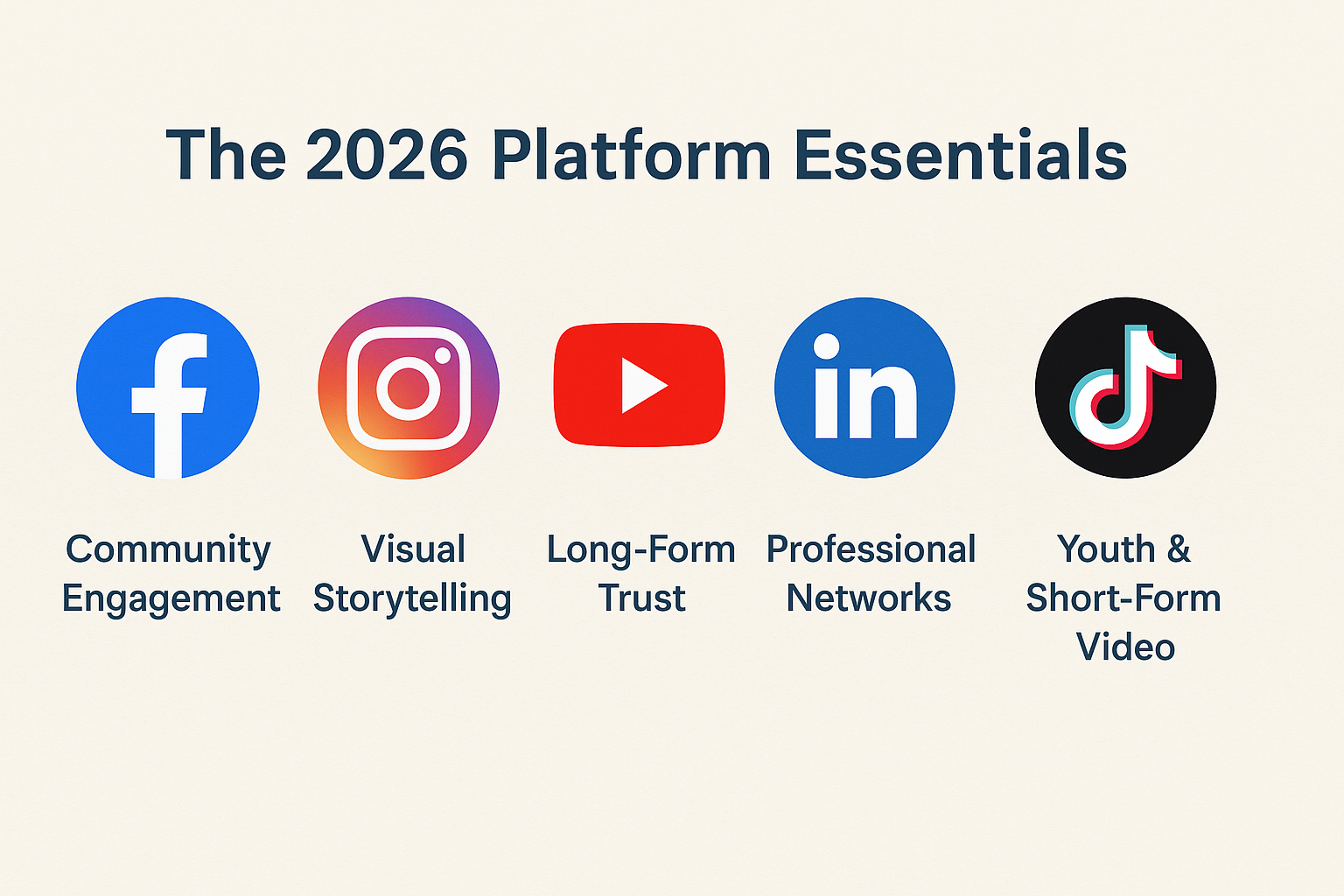
Every organization must select platforms based on alignment — not pressure. Below is your 2026 “Where to Be and Why” breakdown.
Facebook — The Community Relationship Engine
If your audience includes families, donors, or local residents, Facebook is non-negotiable.
Facebook is best for:
- Community announcements
- Events
- Fundraising messages
- Parent communication
- Impact stories
- Local updates
Why it matters: Facebook is still the #1 platform for adults ages 30–65 — the group that donates, volunteers, makes household decisions, and purchases services.
If your community includes adults, families, or donors — Facebook is essential.
Instagram — The Visual Storytelling Platform
Instagram excels at:
- Brand storytelling
- Reels
- Impact stories
- Behind-the-scenes content
- Visual updates
Why small organizations need Instagram: It’s both a search tool and a connection tool — especially for younger and mid-age audiences.
Instagram is where your brand becomes emotionally recognizable.
TikTok — The Fast-Growth, High-Commitment Platform
TikTok is powerful, but only if you can produce:
- Short-form video
- Authentic content
- Behind-the-scenes moments
- Frequent updates
TikTok is optional unless your audience is young and your team can sustain video.
YouTube — The Most Underrated Platform for 2026
YouTube builds:
- Trust
- Credibility
- Deep storytelling
- High SEO performance
Best for:
- Schools (events, tours)
- Nonprofits (donor stories, program highlights)
- Small businesses (tutorials, demonstrations)
If you can film on your phone, you can win on YouTube.
LinkedIn — The Authority Platform for Leaders
LinkedIn drives:
- Partnerships
- Corporate support
- Professional credibility
- Thought leadership
Best for:
- Service businesses
- Nonprofits
- Local government agencies
LinkedIn is where your organization becomes respected as a leader.
Real World Example — How One Business Tripled Engagement by Choosing the Right Platforms
A small home services business was posting everywhere — TikTok, Facebook, Instagram, Pinterest, X — but nothing worked. Their issues:
- No content plan
- No audience clarity
- No platform strategy
VCS Strategy:
- Cut all platforms except Facebook + Instagram
- Implement Reels showing “before/after” repairs
- Add weekly homeowner tips
- Create a simple CTA funnel
Results in 60 Days:
- +300% engagement
- 2,100 new followers
- 47 new service inquiries
Takeaway:
- They didn’t grow by posting more.
- They grew by posting where their audience already was.
The Vivid Perspective Insight — Social Media Is Not About Algorithms. It’s About Alignment.
Organizations lose momentum when they chase trends. They gain momentum when they follow alignment.
Alignment Happens When:
- You choose platforms based on audience, not pressure
- You tell stories that build trust
- You post consistently rather than constantly
- You use content to build relationships, not noise
The Vivid Perspective: Social media is a relationship tool — not a posting tool.
Story Review
Q: What is the best social media strategy for small organizations?
A: Choose 2–3 platforms based on audience behavior, focus on storytelling, and use consistent CTAs.
Q: What content grows fastest in 2026?
A: Short-form video, Reels, educational content, and impact stories.
Q: How do organizations turn followers into customers or donors?
A: Make content helpful, build trust through stories, and always include clear next steps.
Toolkit — Which Platforms Should Your Organization Use?
Small Businesses
✔ YouTube (optional)
✘ Skip TikTok unless youth-focused
✘ Skip X/Twitter
Nonprofits
✔ YouTube
✘ TikTok only for youth programs
Schools
✔ YouTube
✘ TikTok optional
Local Government / Agencies
✔ YouTube
✘ TikTok if mission-appropriate
Glossary — Social Media Terms Made Simple
Boosted Post: A paid promotion of an organic post
CTA: Call to Action (what you want people to do)
Engagement: Likes, comments, shares, saves
Organic Content: Posts not boosted with ads
Reach: How many people see your content
Reels: Short-form Instagram videos
Short-form video: 6–20 second clips
You Don’t Need More Platforms. You Need More Alignment.
You don’t need to dance on TikTok. You don’t need to post seven times a day. You don’t need your team burned out. You need strategic clarity.
In 2026, social media is about:
- Choosing the right platforms
- Sharing the right stories
- Connecting with real people
- Using your limited time wisely
The platforms you choose determine the audience you reach. The stories you tell determine the trust you build. The clarity you communicate determines the impact you create.
Let Vivid Creative Services help you align your social strategy with your mission — and make every post purposeful.
For the DIYer, you can take immediate action 👉 Download the Digital Marketing Works Playbook & Toolkit Your step-by-step guide for SEO, content, and digital strategy.
Become a member of our digital family 👉 Subscribe to The Vivid Perspective Stay ahead with actionable insights every week.
Let’s launch a relationship together 👉 Schedule a Digital Visibility Discovery Session Let’s assess your current SEO, visibility gaps, and growth opportunities.