

The Vivid Perspective: Insights on Branding, Marketing & Storytelling
Holiday Retail Success Series (2.0); Story 1 of 4
Holiday success doesn’t begin during the holidays—it begins with planning.
Quick Answer: Why Should Retailers Start Holiday Marketing Planning in July?
Retailers that begin planning in July often gain a significant advantage over competitors who wait until fall. Early planning provides time to forecast inventory, establish revenue goals, develop marketing campaigns, create content calendars, prepare staff, and optimize customer experiences before the holiday rush begins.
Starting early also helps retailers avoid last-minute decisions, reduce stress, improve campaign performance, and maximize holiday sales opportunities.
Bottom Line: The retailers that win the holiday season are rarely the ones with the biggest budgets. They are often the ones that start planning first.
The Holiday Season Starts Long Before the First Holiday Sale
For many retailers, the holiday season represents the most important revenue opportunity of the year. It is the period when months of planning, marketing, customer engagement, and operational preparation converge into a relatively short window of opportunity. Yet every year, countless businesses make the same mistake: they wait too long to begin preparing. By the time holiday decorations appear in stores and seasonal advertising fills social media feeds, many retailers are already behind. The most successful organizations understand that holiday success is not built in November—it is built during the summer months when thoughtful planning can still influence outcomes.
The reality is that holiday retail planning has evolved significantly over the last decade. Today’s consumers begin researching products earlier, comparing prices across multiple channels, subscribing to email lists, creating wish lists, and engaging with brands long before they make a purchase. Retailers are no longer competing solely during Black Friday or Cyber Monday. They are competing for attention, trust, and consideration throughout the entire customer journey. Organizations that begin planning in July position themselves to influence those decisions earlier and more effectively.

Last year, The Vivid Perspective explored tactical strategies to help retailers increase foot traffic, improve online visibility, leverage social media, and convert shoppers into loyal customers. Those topics remain critically important. However, before a retailer can execute a successful holiday campaign, they must first develop a strategic roadmap. The series, Holiday Retail Success 2.0 shifts the conversation from tactics to strategy, helping retailers understand how planning, forecasting, budgeting, and preparation create the foundation for exceptional results.
The concept of Christmas in July is often viewed as a seasonal promotion or a fun marketing theme. For retailers, however, it should serve as something much more meaningful. It should act as a reminder that the holiday season is approaching quickly and that every week of preparation creates a competitive advantage. The organizations that start planning now will have more time to refine their messaging, secure inventory, coordinate marketing efforts, and prepare memorable customer experiences.
The difference between a stressful holiday season and a successful holiday season often comes down to one simple decision: when planning begins. For retailers seeking stronger sales, better customer engagement, and increased profitability, the time to start preparing is now.
Understanding the importance of early planning is the first step. The next step is understanding why leading retailers consistently begin their holiday preparations months before the first holiday campaign launches.
Why Smart Retailers Begin Planning in July
One of the most common questions retailers ask is, “Why should we start thinking about the holidays in the middle of summer?” The answer is simple: because the holiday season has become increasingly competitive, complex, and demanding. Consumers are exposed to thousands of marketing messages every day, supply chain considerations continue to impact inventory planning, and advertising costs typically rise significantly during the fourth quarter. Retailers who wait until fall are often forced to make rushed decisions that limit their ability to maximize revenue opportunities.
Planning in July provides retailers with something that becomes increasingly scarce later in the year: time. Time allows leadership teams to review historical performance data, identify emerging trends, assess inventory needs, evaluate marketing budgets, and build comprehensive campaigns. Rather than reacting to challenges as they arise, retailers can proactively address potential obstacles before they impact sales performance. This shift from reactive decision-making to strategic planning often separates high-performing retailers from those struggling to meet revenue goals.
Early planning also creates alignment throughout the organization. Marketing teams can coordinate campaign schedules. Operations teams can prepare for increased demand. Sales associates can be trained on seasonal promotions and customer service expectations. Inventory managers can collaborate with vendors and suppliers to secure products before shortages become a concern. When every department works from a shared plan, the customer experience becomes more consistent and effective.
Another advantage of July planning is the ability to test and optimize. Retailers can evaluate advertising creative, refine promotional offers, update website content, and improve email marketing strategies well before peak shopping periods begin. Small improvements made over several months often produce significantly better results than last-minute changes implemented under pressure. Preparation creates flexibility, and flexibility creates opportunities for growth.
Perhaps most importantly, early planning allows retailers to focus on strategy rather than survival. Instead of spending the holiday season putting out fires, leadership teams can focus on delivering exceptional customer experiences, strengthening relationships, and driving long-term loyalty. That strategic mindset often becomes one of the most valuable assets a retailer can possess during the busiest season of the year.
The Retail Leadership Perspective
Retail leaders often view holiday marketing as a promotional activity. The most successful retailers view it as a business growth initiative. Holiday planning affects revenue forecasting, staffing, inventory management, customer experience, technology readiness, marketing performance, and overall profitability. Organizations that approach the holiday season from a leadership perspective rather than a campaign perspective are often better equipped to capitalize on opportunities and navigate challenges.
Once retailers understand why planning should begin in July, the next question becomes clear: What should retailers actually be doing right now to prepare for holiday success?
The Holiday Planning Checklist: What Retailers Should Complete Before September
Retail success during the holiday season begins with preparation. Before Labor Day arrives, retailers should focus on completing several foundational activities that establish a roadmap for the months ahead.
Review Last Year’s Holiday Performance
The first step in planning is understanding what happened previously. Analyze revenue performance, top-selling products, conversion rates, average transaction value, advertising performance, email engagement, customer acquisition costs, and customer feedback. Identifying what worked—and what didn’t—provides valuable insights that can inform future decisions.
Retailers should ask:
- Which products generated the most revenue?
- Which promotions produced the highest return?
- Which marketing channels performed best?
- What customer complaints surfaced during the season?
- Where did operational bottlenecks occur?
Data-driven decisions consistently outperform assumptions.
Establish Holiday Revenue Goals
Many retailers set sales goals without establishing supporting objectives. Effective holiday planning begins with clear revenue targets that align with inventory levels, staffing capabilities, and marketing resources.
Consider establishing goals related to:
- Total holiday revenue
- Average transaction value
- Online sales growth
- Foot traffic increases
- Customer retention
- Gift card sales
- New customer acquisition
Clear goals create focus and accountability throughout the organization.
Forecast Inventory Requirements
Inventory shortages can derail even the most effective marketing campaigns. Retailers should collaborate with suppliers early, evaluate lead times, identify best-selling products, and determine appropriate inventory levels based on historical trends and projected demand.
Strategic inventory planning minimizes lost sales opportunities while helping retailers avoid excess inventory that can negatively impact profitability after the holiday season.
Build a Holiday Marketing Budget
Holiday marketing requires intentional investment. Retailers should allocate budgets for:
- Paid advertising
- Social media campaigns
- Email marketing
- Website improvements
- Photography and video
- Promotional materials
- In-store experiences
- Community events
Budget planning ensures resources are available when opportunities arise.
Develop a Holiday Content Calendar
One of the most overlooked aspects of holiday planning is content development. Retailers should create a detailed content calendar outlining promotional themes, email campaigns, social media posts, advertising schedules, product launches, events, and seasonal storytelling opportunities.
A content calendar helps ensure consistency, reduces last-minute scrambling, and improves campaign effectiveness.
Once the foundational planning work is complete, retailers must turn their attention toward understanding the modern holiday shopper.
Understanding the Modern Holiday Shopper
Holiday shopping behaviors have changed dramatically over the past decade. Today’s consumers no longer wait until Thanksgiving weekend to begin making purchasing decisions. Instead, they spend weeks—and often months—researching products, comparing prices, reading reviews, following brands on social media, and building digital wish lists. Retailers that understand these evolving behaviors can create marketing strategies that meet customers where they are and influence purchasing decisions earlier in the buying journey.
Research consistently shows that consumers begin holiday shopping earlier each year. Economic uncertainty, inventory concerns, and a desire to spread spending across multiple months have encouraged shoppers to begin researching and purchasing products well before traditional holiday promotions begin. This shift creates an opportunity for retailers who engage customers early with relevant content, helpful information, and meaningful offers.
Another important trend is the growth of omnichannel shopping. Consumers may discover a product on social media, visit a retailer’s website to learn more, read online reviews, compare prices, and ultimately purchase the product in-store. Others may begin in-store and complete the transaction online. The customer journey is no longer linear. Successful retailers create seamless experiences across every touchpoint to support these behaviors.
Consumers also expect personalization. Generic promotions and mass marketing messages often struggle to gain attention. Retailers that use customer data, purchase history, and audience insights to create personalized recommendations and targeted communications are often more successful at building trust and increasing conversions. Personalization demonstrates that a retailer understands customer needs and values the relationship.
Most importantly, holiday shoppers are looking for confidence. They want to know they are purchasing the right product, from a trustworthy business, at a fair price. Retailers that focus on education, transparency, customer service, and authentic storytelling often outperform competitors focused solely on discounts. Building confidence ultimately drives purchasing decisions and long-term loyalty.
Understanding customer behavior provides valuable insights, but retailers must also answer several critical planning questions before launching holiday campaigns.

The Top 10 Holiday Planning Questions Retailers Should Answer Now
1. What Are Our Revenue Goals?
Every successful holiday campaign begins with clear objectives. Retailers should establish realistic but ambitious revenue targets that guide decision-making throughout the season. Goals create focus and help leadership teams prioritize resources effectively.
2. Who Are Our Most Valuable Customers?
Understanding your best customers allows you to tailor messaging, promotions, and experiences to the audience most likely to purchase. Customer segmentation should be a foundational component of holiday planning.
3. Which Products Will Drive Revenue Growth?
Not every product deserves equal attention. Retailers should identify hero products, seasonal best-sellers, giftable items, and high-margin offerings that can drive profitability during the holiday season.
4. What Promotions Will Differentiate Our Business?
Competing on discounts alone is rarely sustainable. Consider exclusive products, bundled offerings, loyalty incentives, early access opportunities, gift-with-purchase promotions, and customer appreciation campaigns.
5. Is Our Website Ready?
For many retailers, the website functions as a digital storefront. Ensure product pages, checkout processes, mobile experiences, site speed, inventory visibility, and customer support tools are optimized before holiday traffic increases.
6. How Will We Grow Our Email List?
Email remains one of the highest-performing marketing channels during the holiday season. Retailers should focus on growing subscriber lists well before major campaigns begin.
7. What Role Will Social Media Play?
Social media should support awareness, engagement, storytelling, and product discovery. Planning content early helps maintain consistency and maximize visibility.
8. Do We Have Adequate Inventory?
Inventory shortages can quickly undermine marketing efforts. Align purchasing decisions with projected demand and promotional activities.
9. Is Our Team Prepared?
Staff training, scheduling, customer service expectations, and operational readiness all contribute to holiday success. Employees play a critical role in shaping customer experiences.
10. How Will We Measure Success?
Identify key performance indicators (KPIs) before campaigns launch. Measurement allows retailers to make informed adjustments and improve results throughout the season.
Once these critical questions are answered, retailers can begin building a comprehensive strategy designed to support sustainable holiday growth.
The Five Pillars of Holiday Retail Success
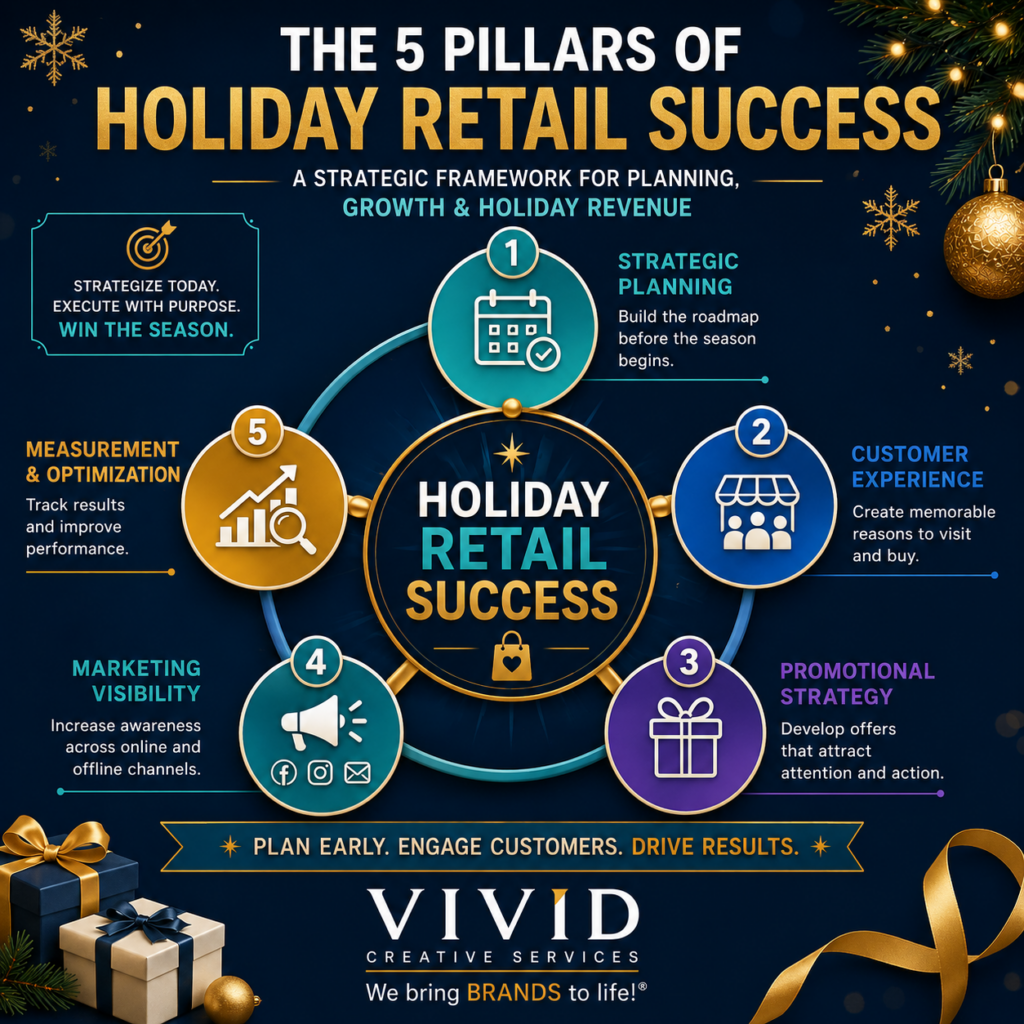
At Vivid Creative Services, we believe successful holiday campaigns are built upon five interconnected pillars that support growth, customer engagement, and profitability.
Pillar One: Strategic Planning
Planning creates direction. Retailers should establish goals, budgets, timelines, responsibilities, and measurement frameworks before executing campaigns. Strategic planning reduces uncertainty and improves decision-making.
Pillar Two: Customer Experience
Every interaction shapes customer perceptions. From website navigation to in-store service, retailers should focus on delivering experiences that are convenient, enjoyable, and memorable. Exceptional customer experiences increase satisfaction and encourage repeat purchases.
Pillar Three: Promotional Strategy
Promotions should support business objectives while delivering value to customers. Effective promotions attract attention, encourage action, and protect profitability. Thoughtful promotional planning often produces stronger results than aggressive discounting.
Pillar Four: Marketing Visibility
Customers cannot purchase products they do not know exist. Retailers should leverage multiple channels—including SEO, email marketing, social media, advertising, public relations, and community partnerships—to increase visibility and awareness.
Pillar Five: Measurement and Optimization
Successful retailers continuously evaluate performance. Monitoring KPIs allows organizations to identify opportunities, address challenges, and improve outcomes throughout the holiday season. Measurement transforms data into actionable insights.
When these five pillars work together, retailers create a stronger foundation for sustainable growth and long-term success.
While understanding success factors is important, retailers must also avoid several common mistakes that frequently undermine holiday performance.
Common Holiday Planning Mistakes That Cost Retailers Sales
One of the most common mistakes retailers make is waiting too long to begin planning. Delayed planning often leads to rushed campaigns, inventory challenges, higher advertising costs, and missed opportunities. Starting early provides flexibility and control.
Another frequent mistake is relying exclusively on discounts. While discounts can drive short-term traffic, they can also erode profit margins and condition customers to wait for promotions. Retailers should balance promotional offers with value-driven experiences and relationship-building initiatives.
Many retailers also underestimate the importance of email marketing. Social media platforms continue to evolve, but email remains one of the most reliable channels for reaching customers directly. Neglecting email marketing can limit engagement and reduce conversions.
Ignoring customer data represents another missed opportunity. Purchase history, website behavior, customer feedback, and marketing performance metrics provide valuable insights that can improve campaign effectiveness. Data should inform strategy rather than sit unused.
Finally, many organizations fail to measure results consistently. Without measurement, it becomes difficult to identify successful initiatives, improve future campaigns, or maximize return on investment. Retailers should establish clear reporting processes and review performance regularly.
Avoiding mistakes is important, but retailers also need a practical roadmap that guides execution throughout the remainder of the year.
Building Your Holiday Marketing Calendar
- July should focus on planning, forecasting, budgeting, inventory management, and campaign development.
- August should emphasize creative development, content creation, email list growth, website optimization, and advertising preparation.
- September should introduce awareness campaigns, early promotions, customer engagement initiatives, and audience-building activities.
- October should focus on campaign launches, product showcases, gift guides, and promotional momentum.
- November becomes execution season, including Black Friday, Small Business Saturday, Cyber Monday, and holiday sales events.
- December should emphasize urgency, customer appreciation, gift cards, last-minute promotions, and post-holiday retention strategies.
A structured calendar ensures activities remain organized, coordinated, and aligned with overall business goals.
Related Holiday Retail Resources
Continue your holiday planning journey with these additional resources from The Vivid Perspective:
- How to Maximize In-Store Foot Traffic for a Thriving Holiday Season (Link)
- Driving Website Traffic and Online Sales: A Retailer’s Guide to Holiday Success (Link)
- Leveraging Social Media to Engage and Attract Holiday Shoppers (Link)
- From Awareness to Action: Converting Holiday Shoppers into Loyal Customers (Link)
- Holiday Retail Success Playbook + Toolkit (Link)
These resources complement the Holiday Retail Success 2.0 series and provide additional strategies for increasing visibility, engagement, and revenue.
Micro FAQ
When should retailers start planning for the holidays?
Retailers should ideally begin planning in July. Early planning provides sufficient time for budgeting, inventory forecasting, campaign development, and customer engagement preparation.
Why is Christmas in July important for retailers?
Christmas in July serves as a strategic reminder that holiday success begins months before the holiday season arrives. It encourages proactive planning and preparation.
What should a holiday retail marketing plan include?
A holiday marketing plan should include goals, budgets, target audiences, promotional strategies, content calendars, inventory plans, advertising schedules, and measurement frameworks.
What is the biggest holiday marketing mistake?
The most common mistake is waiting too long to begin planning. Late preparation often results in rushed decisions and missed opportunities.
How can small retailers compete against larger brands?
Small retailers can compete by focusing on customer relationships, community engagement, personalized experiences, authentic storytelling, and strategic planning.
Conclusion: Holiday Success Begins Today
The most successful retailers understand a simple truth: holiday growth is not created during the holiday season—it is created in the months leading up to it. The organizations that begin planning in July gain the time, flexibility, and strategic advantage necessary to build stronger campaigns, create better customer experiences, and maximize profitability.
Christmas in July is more than a seasonal marketing concept. It is a mindset. It represents the decision to lead proactively rather than reactively. It reflects a commitment to preparation, intentionality, and long-term success. Retailers who embrace that mindset position themselves to enter the holiday season with confidence rather than uncertainty.
As you begin preparing for the months ahead, remember that every successful holiday campaign starts with a plan. The actions you take today can directly influence the results you achieve tomorrow.
Ready to Strengthen Your Holiday Strategy?
Download the Holiday Retail Success Playbook + Toolkit for practical templates, strategic guidance, planning worksheets, and proven tools designed to help retailers increase foot traffic, improve online visibility, and maximize holiday sales. (Link)
Looking for a customized approach? Schedule a Holiday Growth Strategy Session with Vivid Creative Services and discover how strategic planning can help your organization prepare for its most successful holiday season yet. (Link)
Because holiday success doesn’t begin in November. It begins now.