
The Vivid Perspective Series, Digital Marketing Strategies 2026; Part 1 of 4
When Your Organization Is Invisible Online, Your Impact Shrinks
Three months ago, a local nonprofit director told me something that stuck with me: “We do incredible work, but online we feel invisible.”
Their programs were changing lives. Their team was dedicated. Their mission was clear.
But when families searched for help, they found other organizations — not because those organizations were better, but because they were more visible.
And this happens everywhere:
- A small business with great service appears on page 3.
- A school with strong academics never shows up in “best schools near me.”
- A healthcare nonprofit does vital work but ranks below national brands.
- A local government agency can’t get residents to find their information.
Visibility shapes impact. In 2026, search engines, AI engines, and social algorithms decide which organizations get found, trusted, and chosen.
SEO is no longer a marketing accessory. It is a mission amplifier.
If your audience cannot find you, they cannot choose you. This story shows you exactly how to change that — no jargon, no overwhelm, just clarity.
Why SEO Matters More Than Ever for Small Organizations in 2026
SEO used to mean “optimize for Google.” Today, SEO includes:
- Traditional Search (Google, Bing)
- Answer Engines (AEO: Google Answers, Bing Answers, voice assistants)
- Generative AI Engines (GEO: ChatGPT, Gemini, Perplexity, Claude)
- Social Search (TikTok, YouTube, Instagram search bars)
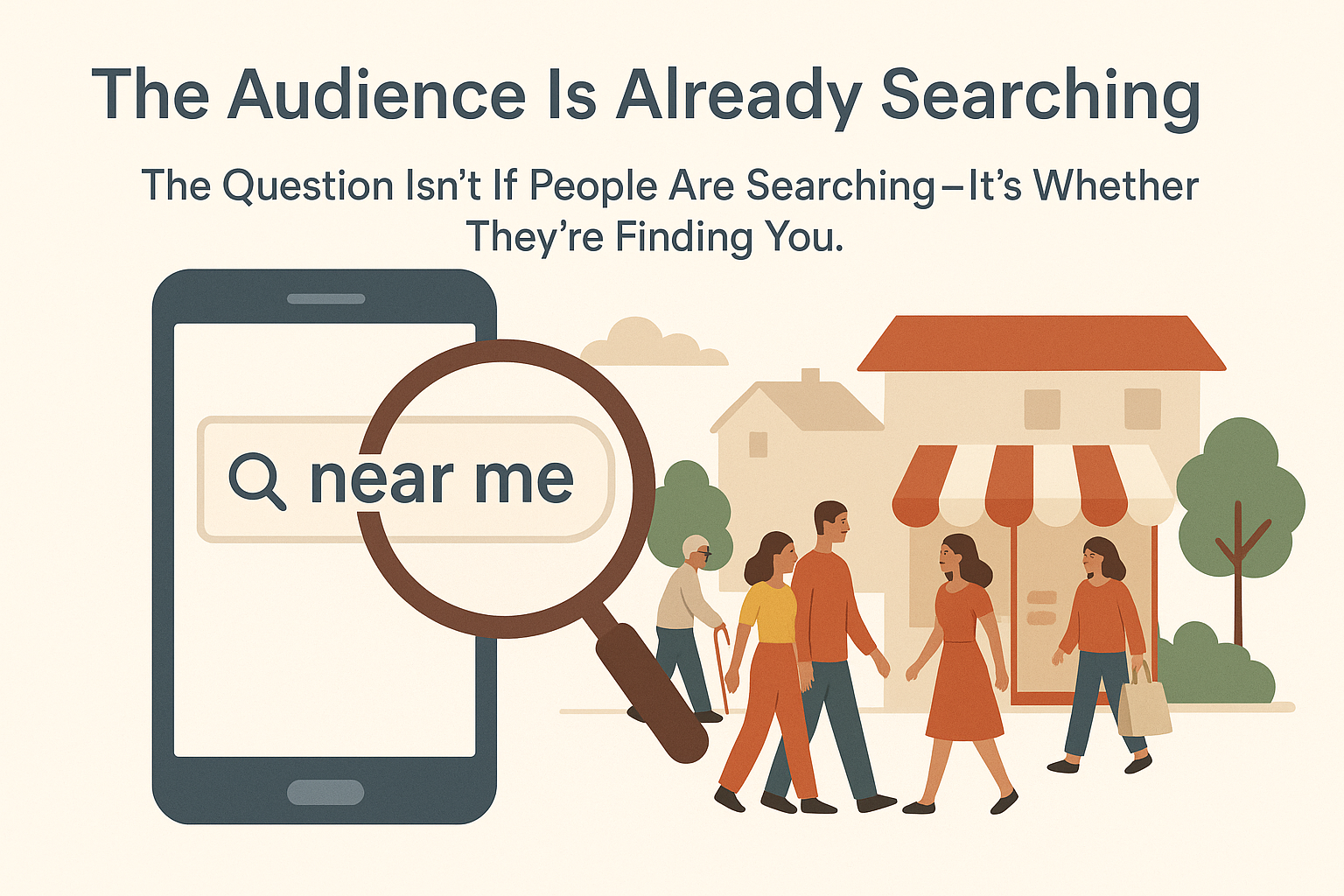
Your audience now searches everywhere. Your organization must appear everywhere.
The simple truth; if your organization isn’t showing up in search results, audiences assume one of two things:
1. You’re not credible.
2. You’re not active.
Neither are true — but visibility shapes perception.
The Core Benefit of SEO in 2026: It connects you with people who are already looking for what you offer. No guessing, no cold outreach — just aligned visibility.
The Top 25 SEO Questions Small Organizations Are Asking in 2026
Below are the most-searched questions from small businesses, nonprofits, schools, and public agencies — answered clearly, directly, and in AEO-ready format.
1. What is SEO in simple terms?
SEO is the process of helping your audience find you online when they search for services, programs, information, or opportunities you provide.
2. How long does SEO take?
Most organizations see early improvements in 45–90 days and major improvements in 6–12 months.
3. What matters most in SEO today?
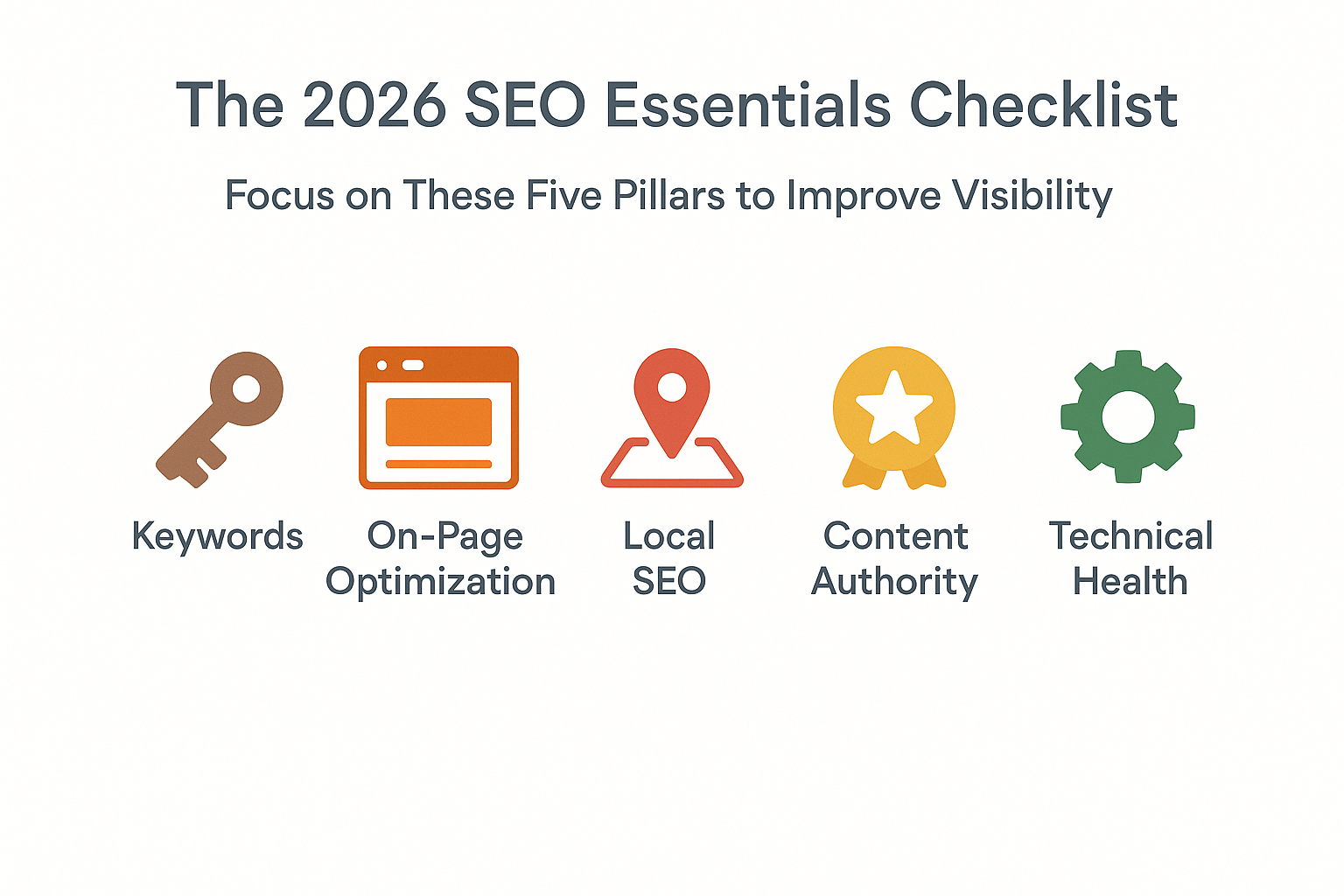
Relevance, clarity, local signals, content depth, mobile performance, and user experience.
4. Do small organizations really need SEO?
Yes — because local search intent is at an all-time high. People search before they visit, call, donate, or enroll.
5. Is SEO expensive?
Not if you follow a clear strategy and focus on the fundamentals before hiring external help.
6. What keywords should I target?
Keywords your audience actually uses — not internal language. (Example: “roof leak repair,” not “premium shingle installation.”)
7. How many keywords do I need?
Each page should focus on one primary keyword and 2–3 secondary keywords.
8. What is “local SEO”?
Local SEO helps your organization appear for searches that include a location or “near me.”
9. Does Google Business Profile matter?
Yes — it is one of the top 3 ranking factors for local search.
10. Do reviews help SEO?
Absolutely. Reviews build trust and signal relevance.
11. How often should I post blogs?
Frequency matters less than quality. In 2026, longer, deeper content outranks shorter weekly posts.
12. Does AI-generated content hurt SEO?
No — unless it’s generic, inaccurate, or thin. AI-assisted content paired with human editorial strategy performs extremely well.
13. What is on-page SEO?
How you structure and optimize each webpage (titles, headers, keywords, links).
14. What is off-page SEO?
Anything outside your website that boosts credibility — reviews, citations, backlinks.
15. Do meta descriptions matter?
Yes — especially for AEO/GEO engines that use summaries to determine relevance.
16. How do I rank for “near me”?
Optimize Google Business Profile, add local keywords, list neighborhoods, and request local reviews.
17. Should nonprofits optimize differently than businesses?
Yes — nonprofits must target donor intent, community intent, and resource intent queries.
18. Why isn’t my organization showing up on Google?
Because your site may lack clarity, structure, keyword alignment, or local signals.
19. How important is mobile SEO?
Critical. Over 60% of local searches happen on mobile devices.
20. Does page speed matter?
Yes — sites that load in under 3 seconds rank significantly higher.
21. What is Answer Engine Optimization (AEO)?
Optimizing for direct-answer boxes (People Also Ask, Featured Snippets, voice search).
22. What is Generative Engine Optimization (GEO)?
Optimizing your content so AI tools like ChatGPT recommend your organization.
23. How long should a webpage be?
Pages that rank well tend to have 800–2,000+ words with structured sections.
24. Do photos and videos help SEO?
Yes — but only when optimized with alt text, captions, and descriptive file names.
25. What is the fastest way to improve SEO?
Optimize Google Business Profile, improve mobile speed, update your homepage with clarity, and publish one strong authority page.
Now that we’ve answered the most searched SEO questions, let’s explore how small organizations can apply these insights immediately.
The Keyword Framework — How to Choose Words Your Audience Actually Searches
Too many organizations choose keywords based on internal language. Your audience uses simpler, more direct terms.
Example: A school might say: “student-centered learning environment.”
But parents search: “best schools near me,” “safe schools,” “affordable tuition.”
Example: A nonprofit might say: “community-based holistic support services.”
But donors search: “charities that help families,” “nonprofits in Kansas City.”
Your 4-Step Keyword Framework:
- Primary Intent Keywords – what you offer
- Secondary Question Keywords – what people ask
- Local Keywords – your city, neighborhoods, or district
- Impact Keywords – social outcomes (for nonprofits/schools)
When you choose the words your audience searches for, not the words you internally prefer, your visibility increases immediately.
Real World Example — How One Small Nonprofit Became Discoverable in 90 Days
A Kansas City–based nonprofit supporting youth mentors came to VCS frustrated by low visibility.
Their challenges:
- Website traffic flat for 18 months
- No rankings for “mentoring programs near me”
- Confusing homepage messaging
- Under-optimized Google Business Profile
- No local keywords
The Solution:
- Revised core messaging for clarity
- Added local phrases (“South Kansas City,” “Grandview,” “Kansas City families”)
- Updated Google Business Profile
- Created one high-authority resource page
- Added community stories featuring local mentors
- Requested 7 new Google reviews
Results in 90 days:
- +62% organic search traffic
- 5 keywords ranking on page 1
- 3x increase in inquiries from families
- 2 new donor leads
- Elevated credibility across the community
The organization didn’t change its mission — just how it communicated it online.
The Vivid Perspective Insight — Clarity Is the New SEO Strategy
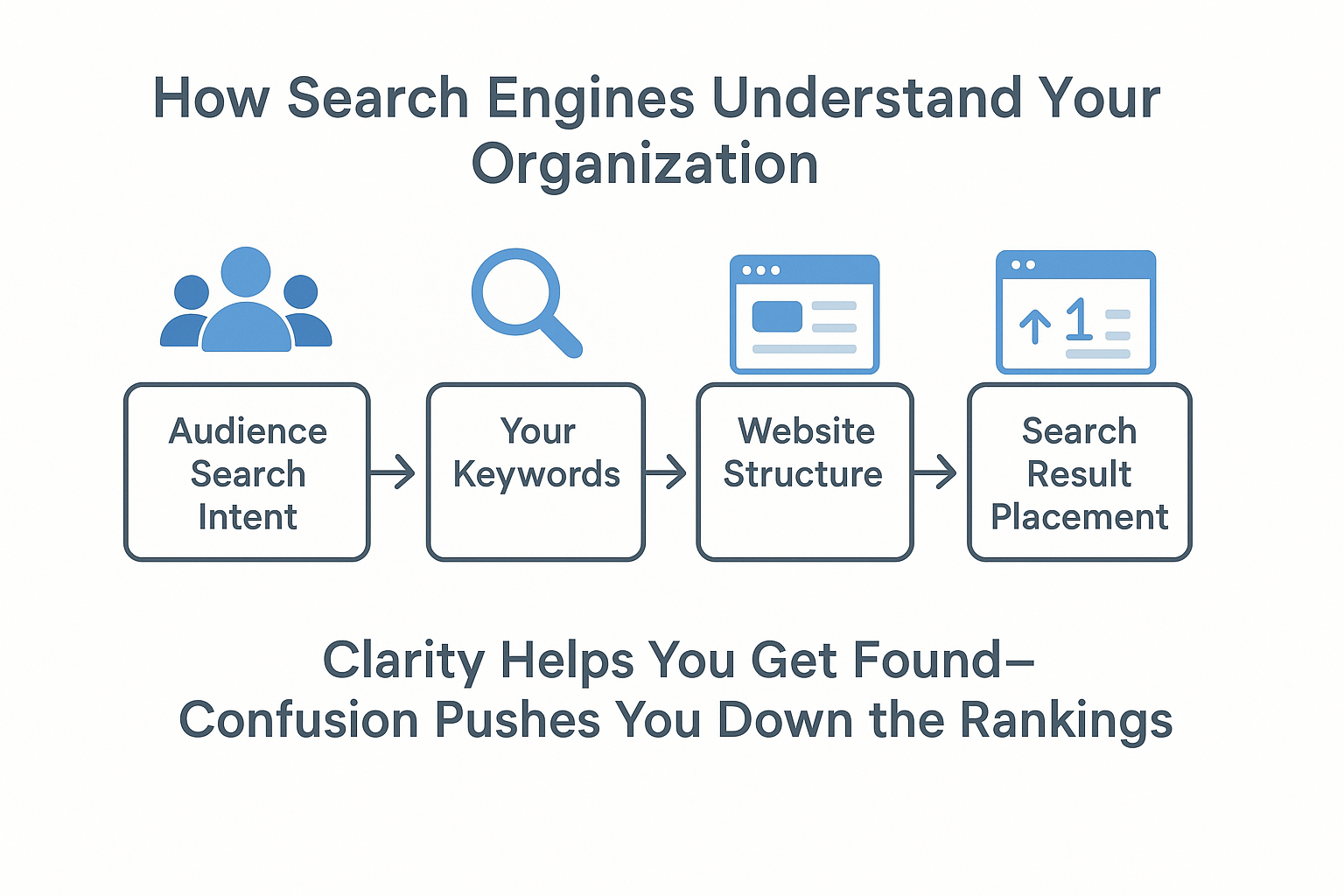
Organizations often believe SEO is about “hacking the algorithm.” It’s not. SEO is about clarity.
- Clear messaging.
- Clear structure.
- Clear answers.
- Clear local signals.
- Clear audience alignment.
Search engines reward what audiences understand. When your website communicates clearly, consistently, and helpfully, algorithms naturally favor you over competitors with more confusing or outdated content.
AEO Answer Blocks — Winning the Featured Snippets and Voice Searches
Voice search and AI responses are becoming primary discovery channels. Use short, direct sentences to claim these positions.
Q: What is the fastest SEO improvement for a small organization?
A: Optimize your Google Business Profile, add local keywords to your homepage, increase page speed, and publish one authoritative page about your services.
Q: What content ranks best?
A: Long-form, helpful, structured content that answers real audience questions.
Q: What should nonprofits optimize first?
A: Program pages, donation pages, and local community pages.
These blocks will help you appear in AI summaries, snippets, and People Also Ask sections.
Local SEO — The Most Important Strategy for Small Organizations
Your community searches locally:
- “dentist near me,”
- “food pantry near me,”
- “youth programs in Grandview,”
- “best schools in Kansas City.”
Local SEO Checklist:
- Google Business Profile fully optimized
- Name, address, and phone consistent
- Local keywords added to core pages
- Neighborhoods and districts listed
- Local reviews requested
- Photos updated regularly
- Events and updates posted monthly
Local SEO meets your audience where they are — physically, emotionally, and digitally.
Technical SEO — A Simple 2026 Checklist for Non-Technical Teams
You don’t need a developer. You need this checklist.
Technical SEO Quick Check:
⬜ Website loads under 3 seconds
⬜ Mobile-responsive
⬜ Secure (HTTPS)
⬜ Structured headings (H1–H4)
⬜ No broken links
⬜ Clear menu navigation
⬜ Alt text added to images
⬜ ADA-accessible content
⬜ Clean URLs
⬜ Minimal pop-ups
Technical SEO succeeds when your site is fast, accessible, and easy to navigate — for humans and search engines.
Glossary — Making SEO Simple for Organizations With Small Teams
- AEO: Answer Engine Optimization
- Backlinks: Links from other sites pointing to yours
- Citations: Directory listings with consistent contact info
- GEO: Generative Engine Optimization
- Internal Linking: Connecting your pages together
- Keyword: Search phrases your audience uses
- Local SEO: Optimizing for location-based searches
- Meta Description: Short page summary that affects clicking
- On-page SEO: How each page is structured
Your Path to Sustainable Visibility Starts Today
SEO isn’t mysterious. It isn’t unattainable. And it isn’t reserved for large organizations with big budgets.
SEO is a clarity system. When your organization communicates clearly — search engines reward you with visibility. When visibility increases — awareness grows. When awareness grows — impact grows.
Your audience is already searching. They need your services. They want your programs.
They are looking for your support.
The only question is: will they find you or someone else? Let Vivid Creative Services help you build a visibility strategy that brings your audience closer, strengthens your digital presence, and turns search into growth.
For the DIYer, you can take immediate action
👉 Download the Digital Marketing Works Playbook & Toolkit – Your step-by-step guide for SEO, content, and digital strategy.
Become a member of our digital family
👉 Subscribe to The Vivid Perspective – Stay ahead with actionable insights every week.
Let’s launch a relationship together
👉 Schedule a Digital Visibility Discovery Session – Let’s assess your current SEO, visibility gaps, and growth opportunities.
Visibility creates opportunity. Opportunity creates growth. Growth creates impact. Let’s build that together.