
The Vivid Perspective: Insights on Branding, Marketing & Storytelling
Holiday Retail Success Series (2.0); Story 2 of 4
The most successful holiday seasons are planned months before the first holiday promotion launches.
Quick Answer: How Do You Build a Holiday Retail Marketing Plan That Drives Revenue?
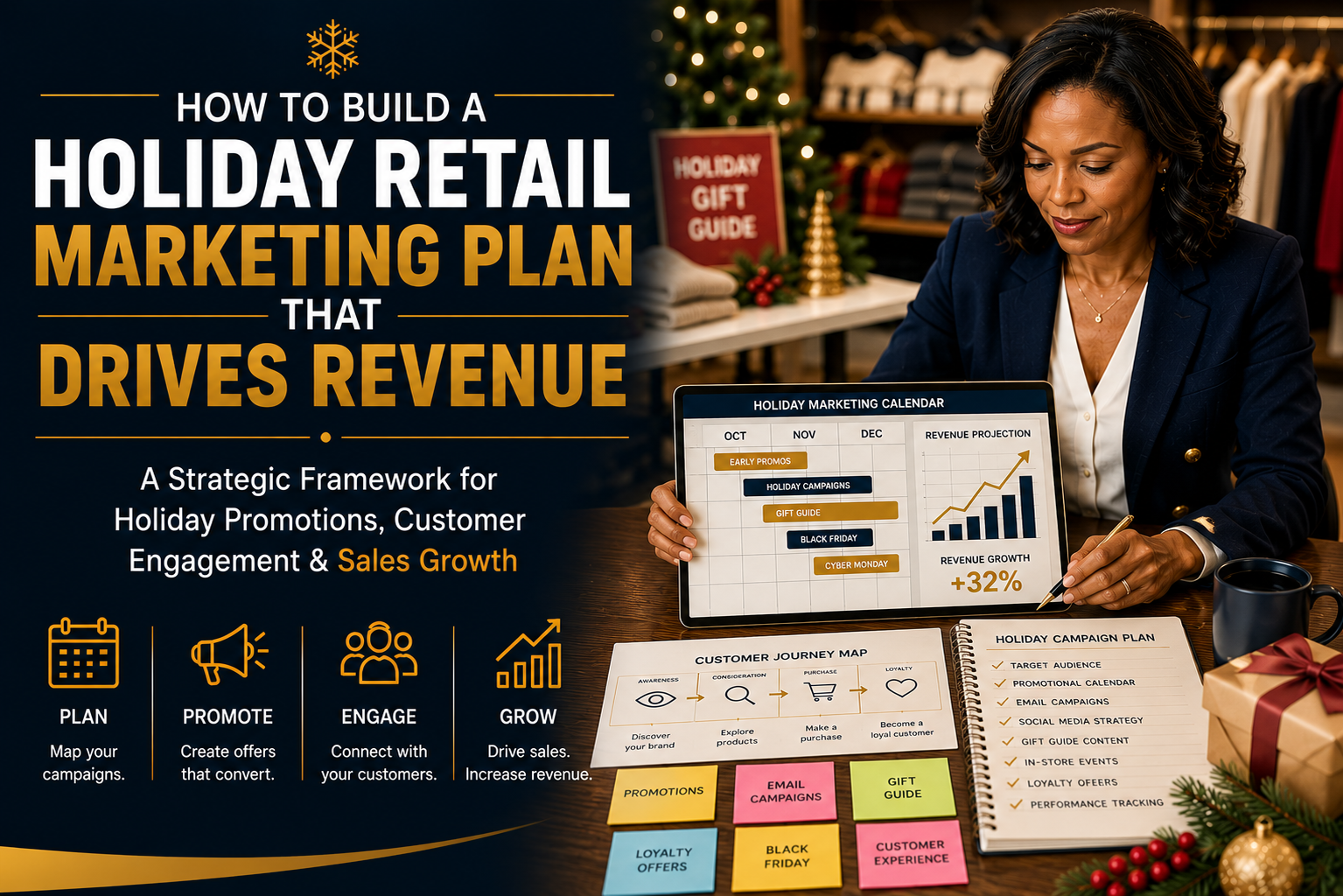
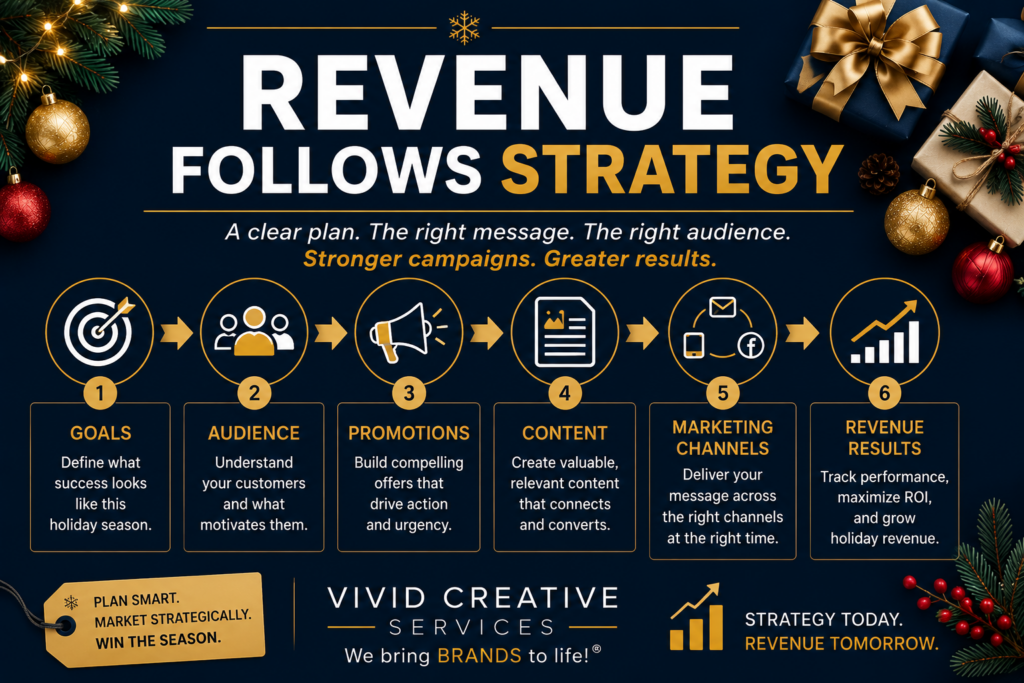
A successful holiday retail marketing plan begins with strategy—not promotions. Retailers that generate the strongest holiday results typically start by establishing revenue goals, identifying priority customer segments, selecting key products and promotions, creating a content calendar, allocating marketing resources, and defining how success will be measured.
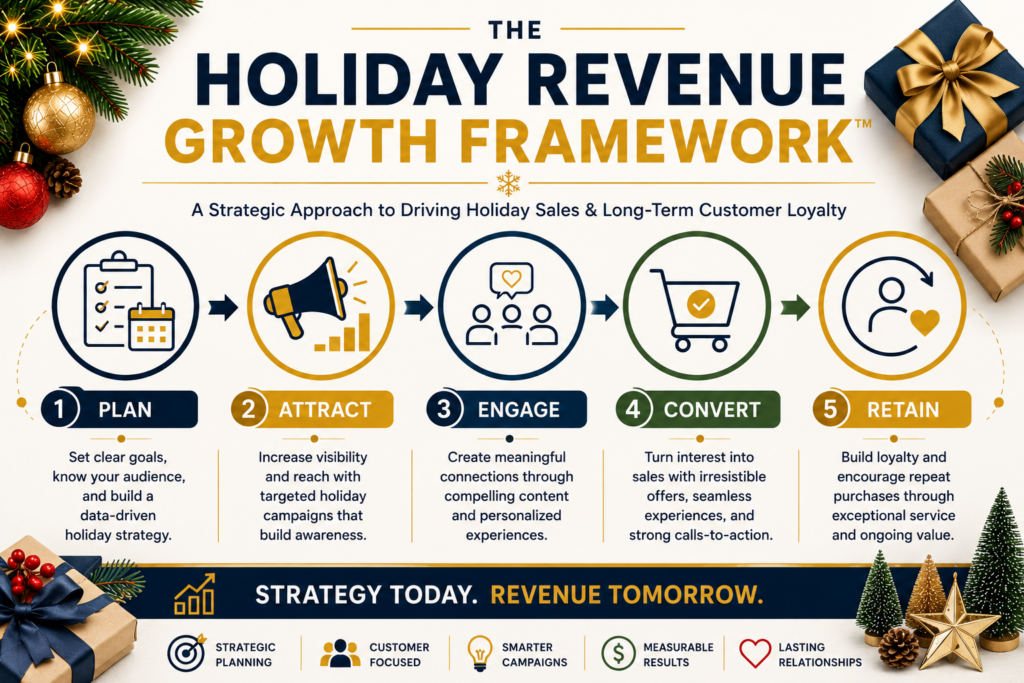
At Vivid Creative Services, we recommend following the Holiday Revenue Growth Framework™:
- Plan – Establish revenue goals, budgets, timelines, and KPIs.
- Attract – Increase visibility through advertising, social media, email marketing, SEO, and community engagement.
- Engage – Create meaningful customer experiences through content, events, gift guides, and promotions.
- Convert – Optimize in-store and online experiences to increase sales and average transaction values.
- Retain – Strengthen customer loyalty through follow-up communication, customer appreciation, and retention initiatives.
Bottom Line: Retailers that build a strategic holiday marketing plan before the season begins are often better positioned to increase sales, improve customer experience, maximize marketing investments, and create long-term customer relationships.
The Difference Between Hoping for Holiday Sales and Planning for Them
Every year, retailers enter the holiday season with high expectations. They hope sales will increase, foot traffic will improve, and customers will spend more than they did the previous year. While optimism is important, successful holiday seasons are rarely built on hope alone. Successful holiday seasons are built on strategic planning, thoughtful execution, and a clear roadmap that aligns marketing activities with business goals. Retailers who invest time creating a comprehensive holiday marketing plan often outperform those who rely on last-minute promotions and reactive decision-making.
The holiday season represents a unique opportunity for retailers to strengthen customer relationships, attract new buyers, increase average transaction values, and generate significant revenue growth. However, increased competition, rising advertising costs, changing consumer behavior, and economic uncertainty make strategic planning more important than ever. A well-developed holiday marketing plan helps retailers navigate these challenges while maximizing opportunities for growth.
In the first installment of our Holiday Retail Success Series (2.0), Christmas in July: Why Smart Retailers Start Holiday Marketing Planning Now (Link), we discussed why smart retailers begin holiday planning in July. Early planning creates time for strategic thinking, forecasting, budgeting, and campaign development. Once that foundation is established, the next step is transforming those insights into a detailed marketing plan that guides decision-making throughout the holiday season.
A holiday marketing plan is more than a collection of promotions or social media posts. It is a strategic framework that defines goals, identifies target audiences, aligns marketing channels, establishes budgets, coordinates messaging, and measures success. The most successful retailers understand that every holiday campaign should support a larger business objective rather than function as a standalone initiative.
The retailers that generate consistent growth during the holiday season often share one characteristic: they operate with intention. They know who they are targeting, what they are promoting, when they are communicating, and how they will measure success. Building that level of clarity begins with a strategic marketing plan.
Before creating promotions and content calendars, retailers must first establish clear goals that define what success looks like.
Start with Clear Holiday Revenue Goals
One of the most common planning mistakes retailers make is launching campaigns without clearly defined objectives. Without goals, it becomes difficult to measure success, prioritize resources, or determine whether marketing investments are generating meaningful results. Every effective holiday marketing plan begins with clear, measurable goals that align with overall business priorities.
Revenue goals should serve as the primary foundation of the plan. Retailers should determine how much revenue they hope to generate during the holiday season and compare that target to previous performance. Revenue goals provide direction and help establish expectations for inventory, staffing, marketing budgets, and promotional activities.
Beyond revenue, retailers should establish supporting objectives that contribute to growth. These goals may include increasing foot traffic, growing online sales, expanding email subscriber lists, improving customer retention, increasing average transaction values, or attracting new customers. Multiple goals create a more balanced view of performance and help retailers focus on long-term growth rather than short-term sales alone.
Goal setting should be realistic yet ambitious. Historical data, market trends, customer demand, and operational capacity should all influence target development. Goals that are too aggressive can create unnecessary pressure, while goals that are too conservative may limit growth opportunities. Finding the right balance requires careful analysis and thoughtful planning.
Most importantly, goals should be communicated across the organization. Marketing teams, sales associates, managers, and operational leaders should understand how their efforts contribute to achieving holiday objectives. Alignment creates accountability and encourages collaboration throughout the season.
Once goals have been established, retailers must determine who they are trying to reach and what motivates those customers to buy.
Identify and Prioritize Your Target Holiday Audiences
Not every customer shops for the same reasons, responds to the same messages, or prefers the same channels. Understanding your audience is one of the most important components of holiday marketing success. Retailers who invest time in customer segmentation often achieve stronger engagement, better conversion rates, and higher returns on marketing investments.
Begin by reviewing existing customer data. Analyze purchase history, demographics, geographic information, product preferences, and buying behavior. Identifying patterns can reveal opportunities to create targeted campaigns that resonate with specific customer groups.
Many retailers find value in developing customer personas for holiday planning. Examples might include last-minute shoppers, value-focused buyers, loyal repeat customers, gift purchasers, or premium shoppers seeking unique products. Understanding these personas helps retailers create more relevant messaging and promotional strategies.
Retailers should also consider potential new audiences. Holiday campaigns often attract customers who may not engage with the brand throughout the rest of the year. Strategic advertising, partnerships, and community engagement initiatives can introduce the business to new buyers and create opportunities for future growth.
Personalization becomes increasingly important during the holiday season. Customers expect brands to understand their needs and provide relevant recommendations. Segmenting email campaigns, tailoring offers, and creating audience-specific messaging can significantly improve campaign performance.
The better retailers understand their audiences, the more effectively they can allocate resources and create meaningful customer experiences.
Once retailers know who they want to reach, the next step is determining what they will promote and why customers should care.
Build a Promotional Strategy That Supports Profitability
Promotions are often the most visible component of holiday marketing, but they should never become the entire strategy. Retailers that rely exclusively on discounts frequently sacrifice profitability while training customers to wait for sales. Effective promotional planning balances customer value with business objectives.
The first step is identifying products that will serve as promotional drivers. Best-selling items, seasonal offerings, giftable products, and high-margin merchandise often make strong candidates. Retailers should evaluate which products align with customer demand while supporting overall profitability goals.
Product bundling can be particularly effective during the holiday season. Bundles increase average transaction values while simplifying purchasing decisions for customers. They also create opportunities to introduce complementary products and improve inventory management.
Gift guides represent another powerful promotional tool. Holiday shoppers often feel overwhelmed by choices. Curated gift guides organized by recipient, price range, or interest can simplify decision-making and increase conversions. Gift guides also create valuable content for websites, email campaigns, and social media platforms.
Retailers should also consider loyalty incentives, exclusive offers, early access promotions, customer appreciation campaigns, and limited-time experiences. These strategies can create urgency while strengthening customer relationships.
The most successful promotions solve problems for customers while supporting business goals. When promotions are built strategically, they drive revenue growth without eroding long-term profitability.
Promotions create excitement, but retailers still need a communication plan that ensures those offers reach the right audience at the right time.
Create an Integrated Holiday Marketing Calendar
A marketing calendar serves as the operational blueprint for holiday execution. Without a calendar, campaigns can become fragmented, inconsistent, and difficult to manage. A structured calendar helps retailers coordinate activities across multiple channels while maintaining consistent messaging.
Start by mapping major seasonal milestones. These may include Halloween, Black Friday, Small Business Saturday, Cyber Monday, Giving Tuesday, Christmas, Hanukkah, New Year’s, and post-holiday clearance events. Identifying key dates provides a framework for campaign planning.
Next, align marketing activities with customer behavior. Awareness campaigns should begin before major shopping periods. Product showcases, gift guides, and educational content should be released early enough to influence purchasing decisions. Promotional campaigns should build momentum as shopping activity increases.
Retailers should coordinate reach efforts across email marketing, social media, website content, advertising, public relations, community partnerships, and in-store experiences. Consistency across channels strengthens brand recognition and reinforces key messages.
Content planning is particularly important. Creating content in advance reduces stress and allows teams to focus on execution during peak periods. Retailers should develop promotional graphics, product photography, videos, email templates, blog articles, and social media content well before campaign launch dates.
A comprehensive marketing calendar transforms strategy into action while helping teams remain organized throughout the season.
While calendars help coordinate activities, retailers must also determine where to invest their marketing dollars for maximum impact.
How to Allocate Your Holiday Marketing Budget Strategically
One of the most challenging aspects of holiday planning involves budget allocation. Limited resources require retailers to make intentional decisions about where to invest marketing dollars. Strategic budgeting helps maximize return on investment while reducing unnecessary spending.
Begin by reviewing historical performance data. Which channels generated the strongest results last year? Which campaigns delivered the highest return? Historical insights can help guide future investment decisions.
Many retailers allocate holiday budgets across several categories:
- Digital advertising
- Social media campaigns
- Email marketing
- Website optimization
- Photography and video production
- Print materials
- Events and sponsorships
- Community engagement initiatives
Budget decisions should align with audience behavior. If customers primarily engage through email and social media, those channels may deserve additional investment. If local foot traffic drives sales, community-focused campaigns and in-store promotions may offer stronger returns.
Retailers should also reserve a portion of the budget for flexibility. Unexpected opportunities and market changes often arise during the holiday season. Having resources available allows organizations to adapt quickly and capitalize on emerging trends.
Strategic budgeting ensures every dollar contributes to achieving broader business objectives.
Once budgets have been established, retailers must determine how success will be measured throughout the holiday season.
Measuring Holiday Marketing Success: Turning Data into Better Decisions
A marketing plan is only as valuable as the results it produces. Unfortunately, many retailers invest significant time and resources into holiday campaigns without establishing clear measurement processes. As a result, they finish the season with plenty of activity but limited insight into what actually worked. Successful retailers understand that measurement is not simply about reporting numbers—it is about gathering intelligence that informs future decisions and improves performance.
Before campaigns launch, retailers should establish key performance indicators (KPIs) that align with their holiday goals. Revenue is an obvious metric, but it should not be the only one. Retailers should also monitor website traffic, conversion rates, average transaction value, email engagement, advertising performance, customer acquisition costs, customer retention, and foot traffic. Together, these metrics provide a more complete view of performance.
Tracking should occur throughout the season rather than only after campaigns conclude. Ongoing measurement allows retailers to identify trends, adjust tactics, and optimize campaigns while opportunities still exist. Small adjustments made during the holiday season can often produce meaningful improvements in results.
Retailers should also evaluate channel performance. Which advertising campaigns generated the strongest return? Which social media platforms drove engagement? Which email campaigns produced conversions? Understanding channel effectiveness helps organizations allocate future resources more strategically.
Perhaps most importantly, measurement helps transform experience into institutional knowledge. Every holiday season provides lessons that can strengthen future planning efforts. Retailers who document those lessons build a competitive advantage that compounds over time.
To help retailers organize their planning efforts, Vivid Creative Services recommends a simple framework that aligns strategy, execution, and measurement.
The Holiday Revenue Growth Framework™
At Vivid Creative Services, we believe holiday success is built through five connected stages that guide customers from awareness to loyalty while supporting business growth.
PLAN
Every successful holiday season begins with planning. Retailers should establish goals, budgets, promotional strategies, content calendars, inventory forecasts, and measurement frameworks before launching campaigns. Planning creates clarity and reduces uncertainty.
ATTRACT
Customers must first discover your business before they can make a purchase. Retailers should focus on increasing visibility through SEO, social media, email marketing, digital advertising, community partnerships, public relations, and local engagement initiatives. Visibility creates opportunity.
ENGAGE
Once customers become aware of your business, retailers must maintain interest. Educational content, product demonstrations, holiday gift guides, events, storytelling, and personalized experiences help build engagement and trust.
CONVERT
At this stage, retailers focus on transforming interest into action. Effective promotions, optimized websites, exceptional customer service, seamless checkout experiences, and strategic merchandising all contribute to stronger conversion rates.
RETAIN
The customer journey does not end after a purchase. Post-holiday communication, loyalty programs, customer appreciation campaigns, referrals, and personalized follow-up help strengthen relationships and encourage repeat business throughout the year.
The Holiday Revenue Growth Framework™ provides a practical roadmap that retailers can use to align marketing activities with business objectives while creating meaningful customer experiences.
Even the strongest marketing plans can be undermined by common mistakes that reduce effectiveness and profitability.
Common Holiday Marketing Plan Mistakes to Avoid
Many retailers make the mistake of treating holiday marketing as a short-term event rather than a strategic growth initiative. This mindset often leads to rushed campaigns, inconsistent messaging, and missed opportunities. The most successful retailers approach holiday marketing as a comprehensive business strategy.
Another common mistake is attempting to market to everyone. Broad messaging often produces weak results because it lacks relevance. Targeted campaigns that speak directly to specific audiences tend to generate stronger engagement and conversions.
Some retailers become overly focused on discounts. While promotions can increase traffic, excessive discounting can erode profitability and diminish perceived value. A balanced strategy should include value-added experiences, exclusive offers, product education, and relationship-building initiatives.
Failing to coordinate channels can also create problems. Customers expect consistency across websites, email campaigns, social media platforms, advertising, and in-store experiences. Disconnected messaging can create confusion and weaken campaign effectiveness.
Finally, many organizations neglect post-holiday retention efforts. Acquiring new customers is important, but retaining those customers often provides greater long-term value. Retailers should develop plans to continue engaging customers after the holiday season concludes.
Avoiding these mistakes allows retailers to focus on execution with confidence while creating stronger customer experiences.
Holiday Retail Success 2.0 Series Resources
As you continue building your holiday strategy, explore these additional resources from The Vivid Perspective:
Previous Story in the Series: Christmas in July: Why Smart Retailers Start Holiday Marketing Planning Now (Link)
Holiday Retail Success Series (1.0)
- How to Maximize In-Store Foot Traffic for a Thriving Holiday Season (Link)
- Driving Website Traffic and Online Sales: A Retailer’s Guide to Holiday Success (Link)
- Leveraging Social Media to Engage and Attract Holiday Shoppers (Link)
- From Awareness to Action: Converting Holiday Shoppers into Loyal Customers (Link)
Featured Resource: Holiday Retail Success Playbook + Toolkit (Link)
These resources provide additional strategies, tools, and insights designed to help retailers improve visibility, increase sales, and create exceptional customer experiences.
Micro FAQ
What is a holiday marketing plan?
A holiday marketing plan is a strategic roadmap that outlines goals, target audiences, promotional activities, marketing channels, budgets, timelines, and measurement strategies for the holiday season.
When should retailers begin creating a holiday marketing plan?
Most retailers should begin developing their holiday marketing plan in July or early August to allow sufficient time for planning, content creation, inventory management, and campaign development.
What should be included in a holiday marketing plan?
A comprehensive plan should include revenue goals, customer segments, promotional strategies, content calendars, budgets, advertising plans, inventory forecasts, staffing considerations, and key performance indicators.
How much should retailers spend on holiday marketing?
Budgets vary based on business size, goals, and market conditions. Retailers should allocate resources based on historical performance, growth objectives, and anticipated opportunities.
How do you measure holiday marketing success?
Success should be measured using metrics such as revenue growth, conversion rates, customer acquisition, email engagement, advertising performance, average transaction value, and customer retention.
Conclusion: Great Holiday Results Start with a Great Plan
The holiday season presents tremendous opportunities for retailers willing to invest in thoughtful planning and strategic execution. While promotions, advertising, and seasonal campaigns often receive the most attention, the true foundation of holiday success is a well-developed marketing plan that aligns business goals with customer needs.
Retailers who establish clear objectives, understand their audiences, build intentional promotional strategies, create integrated marketing calendars, allocate budgets strategically, and measure performance consistently position themselves for stronger outcomes. Rather than reacting to challenges as they arise, these organizations operate with confidence, clarity, and purpose.
Holiday marketing success is not about doing more. It is about doing the right things at the right time with the right strategy.
As you prepare for the months ahead, remember that every campaign, promotion, and customer interaction should support a larger objective. A comprehensive holiday marketing plan provides the roadmap that transforms good ideas into measurable results.
Ready to Build Your Holiday Marketing Plan?
Download the Holiday Retail Success Playbook + Toolkit for practical templates, strategic guidance, planning worksheets, and proven tools designed to help retailers increase foot traffic, improve online visibility, and maximize holiday sales. (Link)
Looking for a customized approach? Schedule a Holiday Growth Strategy Session with Vivid Creative Services and discover how strategic planning can help your organization prepare for its most successful holiday season yet. (Link)
Because successful holiday seasons don’t happen by chance. They happen by design.