
The Vivid Perspective Series, 2025 ReCap & Planning Ahead, Part 2 of 4
Building the Foundation for Your 2026 Marketing Strategy
As 2025 comes to a close, businesses, nonprofits, and local government agencies have a unique opportunity to reflect on their performance and chart a stronger course for the year ahead.
A well-designed marketing strategy is not just a plan on paper—it’s the roadmap that connects your organizational goals to measurable marketing actions. Yet, many organizations enter a new year with vague ideas instead of a structured plan. To succeed in 2026, leaders must take a disciplined approach: assess past results, clarify objectives, define priorities, and align resources. A strategy built on clarity and intentionality ensures your marketing isn’t just busy, it’s impactful.
Reflecting on 2025: What Worked, What Didn’t
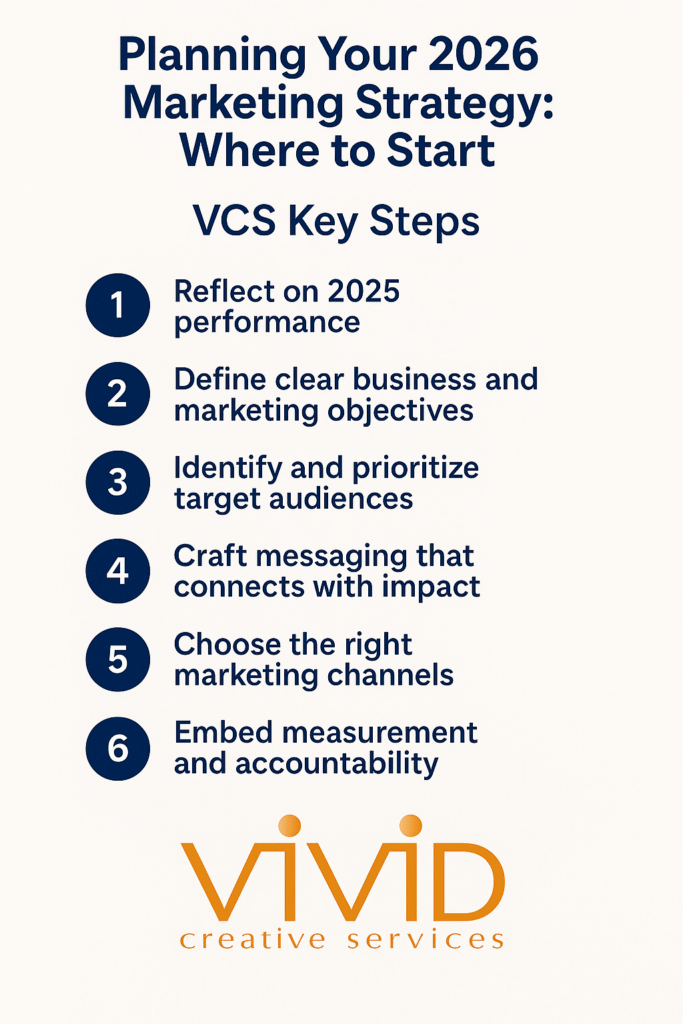
The best place to start planning for 2026 is by looking back at 2025. Marketing success isn’t only about setting new goals—it’s also about learning from past performance. Reviewing key metrics such as campaign ROI, lead generation results, engagement rates, or donor retention helps identify strengths to build on and weaknesses to correct. For example, a nonprofit that discovered its Giving Tuesday campaign drove 40% of year-end revenue can plan to replicate and expand those tactics. Conversely, a local retailer who saw minimal results from untargeted social ads can shift dollars toward proven channels. Reflection provides the insights that prevent wasted effort in the new year.
Defining Clear Business and Marketing Objectives
Once reflection is complete, the next step is setting clear, aligned objectives. Business growth targets, whether they involve revenue, membership, donor acquisition, or program enrollment—should directly inform marketing priorities. If a healthcare nonprofit’s business goal is to expand services into three new communities, the marketing objective might be to generate awareness among residents and secure 200 new patient registrations. Too often, organizations confuse marketing activity with marketing objectives. Running a campaign is not a goal—driving measurable results is. Clear objectives keep teams focused, provide accountability, and ensure every dollar spent supports the bigger picture.
Identifying and Prioritizing Target Audiences
No strategy can succeed without clarity on who you are trying to reach. Audience definition goes deeper than demographics—it involves understanding needs, motivations, pain points, and decision-making behaviors. A small business may prioritize high-value repeat customers, while a local government agency may focus on underserved residents who lack access to programs. Segmenting audiences into groups allows for targeted messaging and efficient resource allocation. For example, a school district could prioritize campaigns for both prospective families and community voters, tailoring the message to each. Prioritization ensures your efforts are laser-focused on the audiences most likely to drive success in 2026.
Crafting Messaging That Connects With Impact
Once audiences are defined, messaging becomes the bridge between your brand and your goals.
In 2026, clarity, authenticity, and alignment will be more critical than ever. Organizations must move beyond generic promotions to stories that resonate with values and inspire action. A nonprofit can tell stories of lives changed by donor support; a business can highlight customer success stories; a government agency can show community improvements from program participation. Consistent brand messaging across digital, print, and in-person channels ensures audiences recognize and trust your organization. Without clear messaging, even the best campaign tactics will underperform.
Choosing the Right Marketing Channels for 2026
In today’s fragmented media environment, not every channel is right for every organization. Your 2026 marketing strategy must balance reach with relevance. Digital marketing will remain essential, but traditional methods—such as direct mail or local print—can still deliver strong results for certain audiences. The key is understanding where your target audience spends time and makes decisions. For example, small businesses may rely heavily on social and email marketing, while a government agency may see success with community events supported by digital outreach. Channel selection should always follow audience insights, ensuring resources flow where they’ll have the most impact.
Building a Flexible but Focused Budget
The marketing strategy is only as strong as the resources behind it. Planning for 2026 requires aligning budget with objectives, not simply repeating last year’s numbers. Organizations should allocate funds toward the tactics with the highest demonstrated ROI while leaving room for innovation and experimentation. For example, a nonprofit may budget 40% of spend for donor acquisition, 30% for retention, and 30% for brand awareness. Small businesses can prioritize dollars toward campaigns that directly drive sales. A flexible budget allows you to shift resources mid-year if performance metrics signal underperformance. A focused yet adaptive approach ensures maximum impact.
Embedding Measurement and Accountability
The most common mistake in annual planning is forgetting to embed accountability. Without clear metrics and reporting, even the best strategy will fail. Each 2026 marketing objective should include measurable KPIs and defined timelines for review. For instance, a nonprofit aiming for 20% donor growth should track monthly acquisition numbers, retention rates, and cost per donor. A business planning for $500,000 revenue growth must monitor campaign ROI, conversion rates, and customer lifetime value. Accountability transforms a marketing strategy into a management tool, giving leadership confidence that marketing is not just busy—but effective.
Real-World Example: A Nonprofit’s Annual Planning Success
Consider a regional nonprofit that struggled with flat donations for several years. In 2024, they adopted a formal strategic planning approach. By reflecting on past performance, they learned that their strongest donor acquisition came from community events, but their messaging was inconsistent. In 2025, they set clear objectives: increase donor retention by 15% and expand their recurring donor program. They prioritized loyal donors as their target audience, refined messaging to emphasize long-term impact, and allocated budget to donor engagement campaigns. By year’s end, recurring donations grew by 22%, proving the power of intentional planning. Their success story underscores why annual strategy is critical for all organizations.
Turning Your 2026 Marketing Plan Into Action
Planning is only valuable if it leads to execution. To bring your 2026 strategy to life, assign clear responsibilities, set timelines, and create a rhythm of ongoing review. Build quarterly checkpoints to measure progress and adjust as needed. Encourage team alignment by making strategy a living document, not a static file. When everyone knows the objectives, understands their role, and has visibility into results, execution becomes consistent and impactful. Successful organizations don’t just plan once—they live the plan every day of the year.
Setting Your Organization Up for 2026 Success
The start of a new year is more than a calendar milestone—it’s a chance to reset, refocus, and realign marketing to your true business objectives. By reflecting on past results, clarifying goals, prioritizing audiences, refining messaging, selecting the right channels, and embedding accountability, you lay the foundation for growth in 2026. Whether you’re a small business seeking higher revenue, a nonprofit aiming for donor growth, or a local government improving community engagement, intentional planning is the key to measurable success.
Every successful year starts with a smart plan. The Year-End Marketing Playbook + Toolkit helps you build a focused, data-driven strategy that aligns your marketing goals with real business growth.
Ready for expert guidance? Contact Vivid Creative Services to turn your 2026 strategy into a clear, actionable roadmap.